tea.toys ENRU中文DEESFRJA

line one — the nine · bound to the constellation

Aya

This is Aya: bud and two leaves — she is that measure herself, and by her they check what goes into the basket.

full GLB · Hunyuan · full GLB · Hi3D

downloads open after a one-email sign-in — that is how the registry knows its guests

drag to rotate — a light 2 MB copy; full models below

Tea. 一芽二叶 yī yá èr yè · picking standard, benchmark of the family

Headwear. 包头 bāotóu · cloth wrap ring, crown left open

In one phrase. This is Aya: bud and two leaves — she is that measure herself, and by her they check what goes into the basket.

Who she is

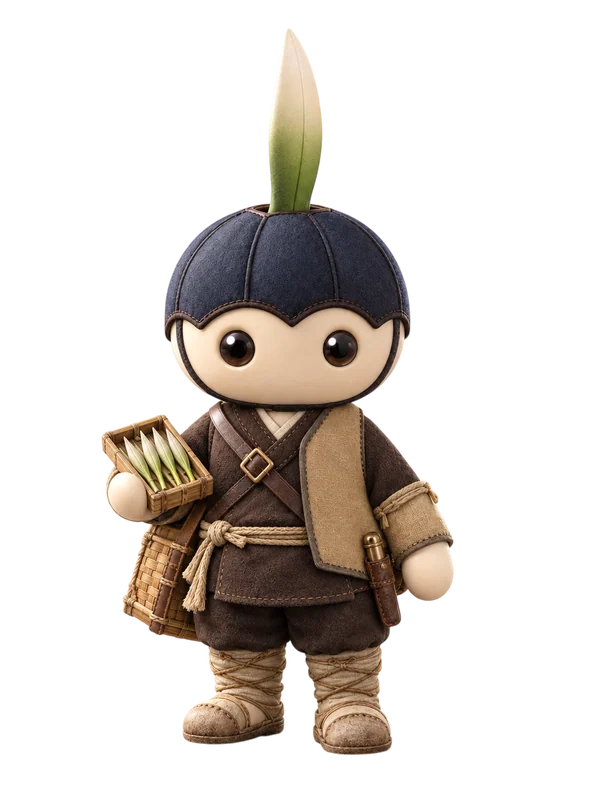
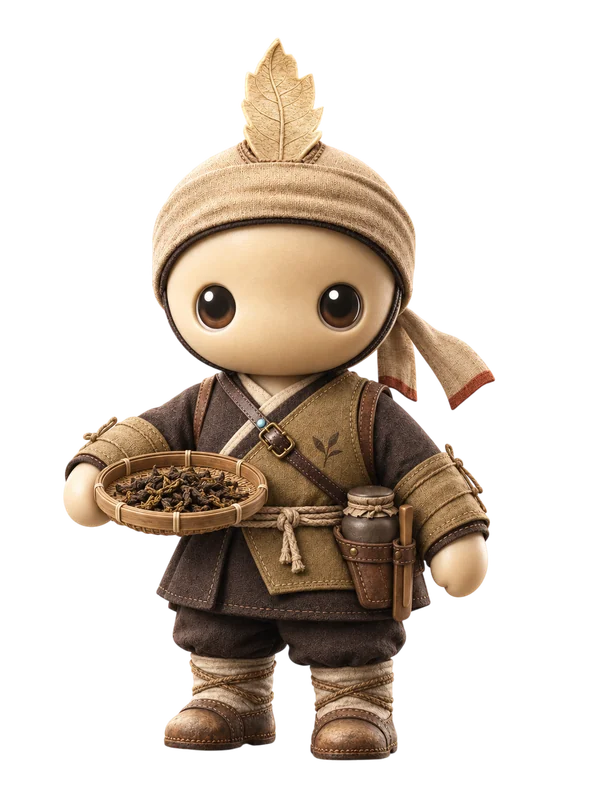
Aya is a creature of the tea mountains, palm-sized: smooth earless head, large eyes, paddle hands without fingers. On her crown sits one closed silvery bud, and on the sides of her head, below eye level, grow two dense leaves angled downward and outward. Together these are exactly what tea mountains in China call 一芽二叶 yī yá èr yè — bud and two leaves, the usual picking measure. She is that measure herself: not a supervisor and not a judge, but a sample to check against, the way one checks against a weight. The head is wrapped in undyed homespun, the crown left open — the bud stands free, the leaves emerge from under the lowest coil. Her work is simple and repetitive: walking rows, looking at shoots and deciding whether a row is ready.

Where she comes from

Yunnan, Lancang Lahu Autonomous County in Pu’er Prefecture, Jingmai Mountain 景迈山 Jǐngmài shān — gentle forested slopes from about 1200 to 1600 meters, where old tea trees stand mixed with young bushes under the forest canopy. The measure she carries belongs to no single mountain: the same count applies on Nannuo Mountain 南糯山 Nánnuò shān in Menghai and on any other slope, so she is seen across Yunnan and beyond. The headwear is a cloth wrap, an everyday item of the tea mountains; no plaques, no pendants, no specific ethnic pattern on it, deliberately.

How she relates to tea

Her growth and her headwear are one tea thing taken apart. The bud on the crown and the two leaves on the sides of the head add up to 一芽二叶: a closed terminal bud plus two already unfolded leaves below it — the most common grade of fresh material by which leaf is accepted at the factory. The bud is silvery and closed because in standard picking it has not yet opened; the leaves are dense, with a raised central vein and a short petiole at the skin, because they are the second and third leaf of the shoot, already working leaves, not downy ones. The headwear works the same way: the wrap creates no brim at all — the area above the head must stay empty so the bud sits in plain view and the leaves come out below the eyes unobstructed. Nothing else can be put on her head without hiding the very measure she exists for. And she plucks the way plucking is actually done: 提采 tí cǎi, lifting with the fingers, not the nail — 掐采 qiā cǎi leaves a dark crushed cut, and it turns red while still in the basket.

What she does

What she never does

Temper

Attentive, measured, unhurried. By default she is in calm waiting: she is not bored standing before a bush doing nothing, because waiting for the right day is half her work. She gets annoyed at exactly one thing — at the request to “take a bit more, no one will notice.”

What she teaches

Through her it is easy to explain that tea quality is set on the bush, not in the oven, and that “more tender” does not mean “better” — it means “for a different process.” A single bud goes to white needle, bud with two leaves goes to green and red tea, a mature shoot of three or four leaves without the bud, 开面采 kāi miàn cǎi, goes to oolong, coarse leaf with petiole goes to dark tea. One and the same bush yields material for different teas, and the difference starts with what was plucked and on what day.

Season and hour

Spring: on Yunnan slopes early picking starts as early as March and holds until 谷雨 gǔ yǔ, roughly the twentieth of April; she has a short second pass in autumn, but the main one is spring. The hour is morning: she goes out when dew has cleared and leaves before the midday heat, because warm leaf spoils in the basket faster than it can be carried in.

Who she intersects with

With Zhunya she has the most direct exchange: 滇红 diān hóng from Fengqing and Lincang is made from exactly her handful, bud with one or two leaves, except the leaf goes not to pan-firing but to withering and oxidation — the same shoot, a different fate. Anczi waits for her basket and first thing counts the blind pairs in it; whatever Aya picks before noon, with Anczi by evening is already in a thin layer. Pusha works the same shoot but takes only the unopened bud — they share one bush and one hour, and Aya sets aside shoots for her where the second leaf has not yet opened. Yanta receives her leaf in the evening and takes it into the shade for the night: the day is hers, the night is Yanta’s. With Ugolek the link is reversed — in autumn he takes exactly what she left in spring: mature leaf with petiole, made into coarse material for pressing. Suncha is her neighbor on the mountain, but they do not cross in work: he walks the old trees, where shoots are few and intervals long, while she works the bushes and young branches. With Yanka they diverge in the substance of the work: oolong is picked 开面采, as a mature shoot without the bud, and where Yanka waits for the shoot to open its face, there is nothing for Aya to do. Bayczi she sees least of all: with her the leaf is already dry and over coals — they are linked only by the count, because Bayczi can tell from the finished tea what was in the basket.

What is deliberately left out of the lore

“Chosenness” is removed: the word “benchmark” here means only that she is measured against like a weight, not that she outranks the other eight. Ethnic attribution is removed — the wrap is left as undyed homespun with no plaques, pendants or pattern, because assigning a specific people (Blang, Hani, Dai, Va, Yi) to a creature is not acceptable, and this headwear is worn on all these mountains. The miraculous intuition is removed: she does not hear the bush and does not sense the tea — she looks and counts, and that can be replicated. The basket on the back and the carrying pole are rejected: the pair “cone plus pole” pulls toward the coolie picker cliché, and her hands are deliberately empty. The motif “Mingqian picking is the most expensive” is rejected: price is not her subject, her subject is the fit between material and process, not prestige. Spring poetry about awakening and young green is rejected too — for her, spring is a schedule, not a mood.

What is fact and what is assumption

Real and verifiable. 一芽二叶 yī yá èr yè is a real and widespread grade of fresh tea material alongside 单芽, 一芽一叶, 一芽三叶; leaf intake is built on it. 对夹叶 duì jiā yè is a real term for a shoot with a stopped terminal bud; such material is considered coarse and does not go into standard picking. 鱼叶 yú yè, “fish leaf,” is the first underdeveloped scale-like leaf at the base of the shoot, and the rule to pluck above it, leaving the leaf on the bush, is real agronomic practice. 提采 versus 掐采 is a real contrast: a cut pressed by the nail darkens and oxidizes prematurely. 露水叶 and 雨水叶 are real terms for leaf picked in dew or rain, and the ban on such picking is practical, not poetic. 摊放 tān fàng, spreading fresh leaf in a thin layer before further processing, is a standard operation. 开面采 kāi miàn cǎi for oolong (mature shoot without bud) and coarse material with petiole for dark tea are real differences by type. 滇红 from Fengqing and Lincang is in fact made from bud with one or two leaves of the large-leaf variety. The geography is real: Jingmai Mountain in Lancang Lahu Autonomous County, Pu’er Prefecture (ancient tea gardens, inscribed on the World Heritage list in 2023) and Nannuo Mountain in Menghai County, Xishuangbanna. 包头, the cloth wrap of the head, is an everyday headwear of Yunnan tea mountains. 谷雨 is a real solar term, around April 20.

Artistic assumption. The creature itself, its growth and headwear are fiction; none of the nine is a recorded folklore character. The distribution of the nine across seasons and hours is a set construction, not an ethnographic fact. Jingmai’s elevation is given rounded (about 1200–1600 m); the actual garden elevations vary by slope, and I do not fix an exact figure. The hours “after dew clears to before midday heat” are a generalization of practice: dew clears differently depending on slope, aspect and weather, and there is no canonical interval. Spring picking dates for Yunnan are given as a range; they drift by year and elevation. Sorting a handful into exactly four piles is a simplification: in real intake, the defect nomenclature for fresh material is broader. I deliberately cite no specific GB/T numbers: the project rule is to verify standard figures against the image rather than from memory, and such verification was not carried out here.

Wardrobe — 39 project costumes

every costume is a project of THE TEA constellation

Aya — costume of the academy project
academy
Aya — costume of the atlas project
atlas
Aya — costume of the community project
community
Aya — costume of the degree project
degree
Aya — costume of the doctor project
doctor
Aya — costume of the dog project
dog
Aya — costume of the energy project
energy
Aya — costume of the equipment project
equipment
Aya — costume of the events project
events
Aya — costume of the express project
express
Aya — costume of the fitness project
fitness
Aya — costume of the florist project
florist
Aya — costume of the furniture project
furniture
Aya — costume of the glass project
glass
Aya — costume of the gratis project
gratis
Aya — costume of the mafia project
mafia
Aya — costume of the main project
main
Aya — costume of the money project
money
Aya — costume of the photo project
photo
Aya — costume of the place project
place
Aya — costume of the puerh project
puerh
Aya — costume of the report project
report
Aya — costume of the restaurant project
restaurant
Aya — costume of the school project
school
Aya — costume of the services project
services
Aya — costume of the shop-puerh project
shop-puerh
Aya — costume of the shop project
shop
Aya — costume of the style project
style
Aya — costume of the support project
support
Aya — costume of the surf project
surf
Aya — costume of the taxi project
taxi
Aya — costume of the teamotea project
teamotea
Aya — costume of the toys project
toys
Aya — costume of the travel project
travel
Aya — costume of the us-com project
us-com
Aya — costume of the villas project
villas
Aya — costume of the wholesale project
wholesale
Aya — costume of the worldtea project
worldtea
Aya — costume of the yoga project
yoga

Scenes

Aya in the sceneAya in the scene

← back to the line