tea.toys ENRU中文DEESFRJA

line one — the nine · bound to the constellation

Pusha

This is Pusha — he does nothing with the leaf, and that is the whole job.

full GLB · Hunyuan · full GLB · Hi3D

downloads open after a one-email sign-in — that is how the registry knows its guests

drag to rotate — a light 2 MB copy; full models below

Tea. white tea 白茶 · 白毫 bái háo, silver down

Headwear. 平顶笠 píngdǐnglì · flat disc without a crown

In one phrase. This is Pusha — he does nothing with the leaf, and that is the whole job.

Who he is

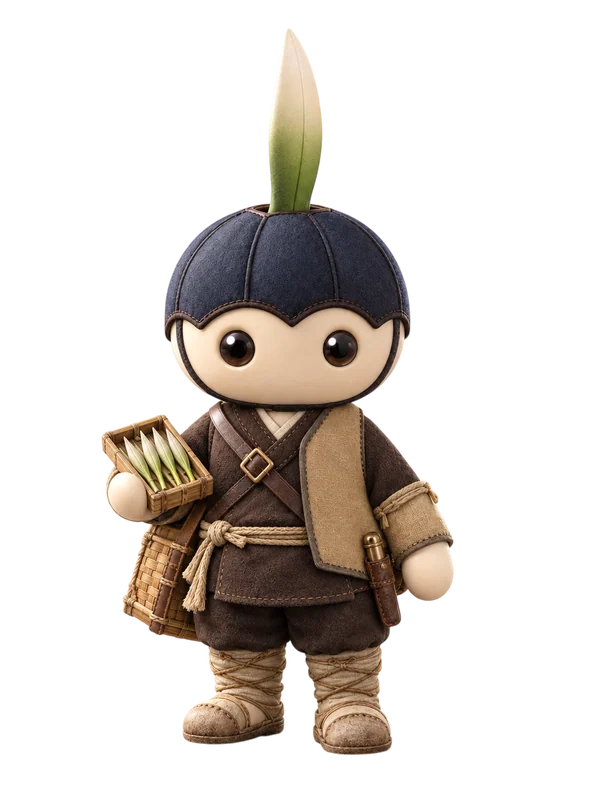
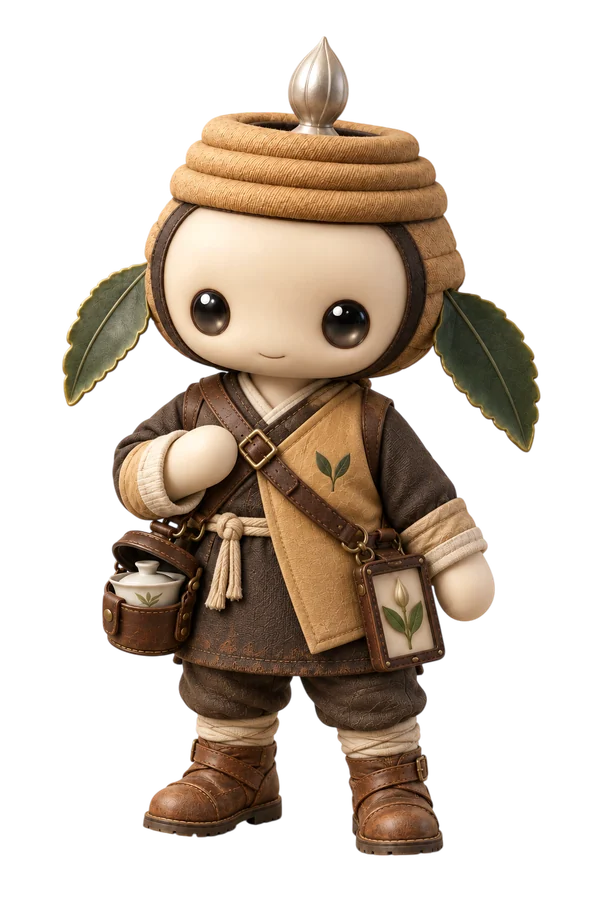
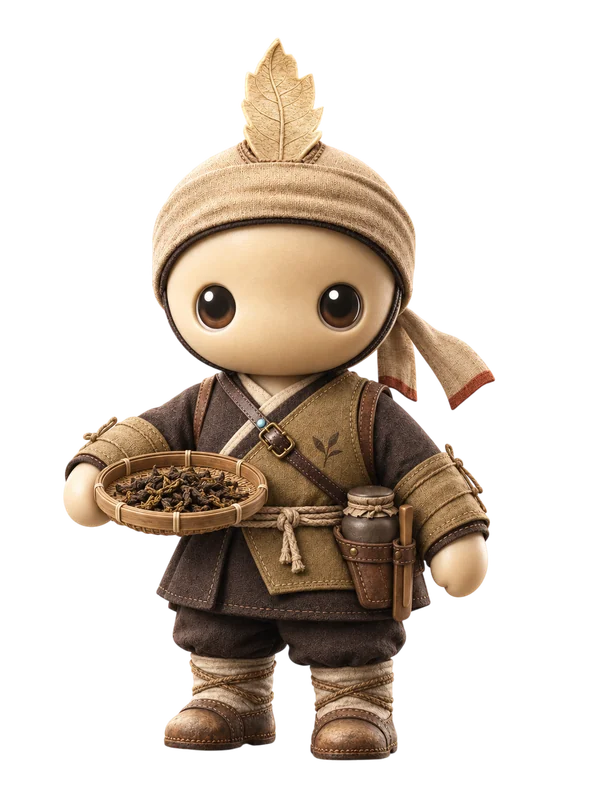
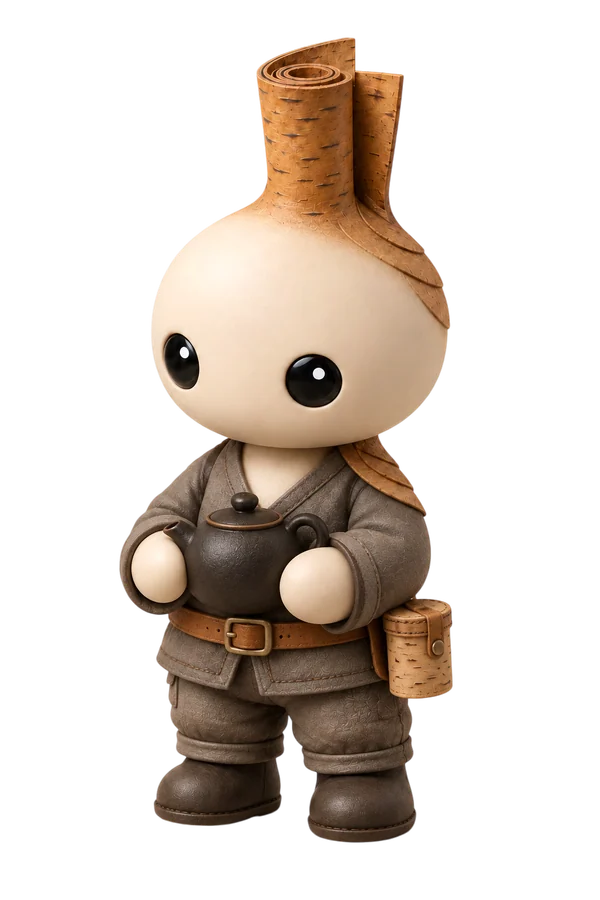
Pusha is a palm-sized creature, one of those that live by tea mountains and are busy with work, not miracles. His body is a barrel, slightly wider than tall, his head almost a sphere, his hands paddle-like without fingers, and he has no ears at all. Silver down lies on him in exactly four places: a standing ruff around the shoulders with a narrow gap under the chin, one downy peak on the crown, two flat rosettes at the eyes, and a thin frost on the backs of the hands and the tops of the feet. Between these places bare matte skin of a pale silver-jade tone shows through — he is not a furry little animal, but a creature whose down grows where it grows on a tea bud: on the bud itself and at its base. His work is simple to say and hard to do — do nothing with the leaf. Lay it out, carry it out, carry it in, let it dry, do not touch it. That is how white tea is made.

Where he is from

Northeastern Fujian, county-level city 福鼎 Fúdǐng in Ningde Prefecture, the slopes of 太姥山 Tàimǔ Shān and the wooded high townships beyond — above all 磻溪 Pánxī, where the most mountain-grown pluckings come from, and the trading town 点头 Diǎntóu, where the sieves are hauled down. The place is documented down to the bush: the white bud here comes from two state varieties — 福鼎大白茶 fúdǐng dàbáichá and 福鼎大毫茶 fúdǐng dàháochá — and the second carries 毫 háo, down, in its very name: its bud is more densely haired. Pusha did not appear “in the mountains in general,” but on that side of the slope where the morning sun is gentle and early slips behind the ridge — on such an exposure the sieves are brought out earlier and carried in earlier. His second home is 政和 Zhènghé in Nanping, where the same tea is withered not in open sun but in ventilated buildings; he goes there to watch the same thing done differently.

How he is connected to tea

White tea is the only class where between bush and cup there is neither kill-green nor rolling: 不炒不揉 bù chǎo bù róu, no frying and no kneading. Only withering 萎凋 wěidiāo and drying. That is exactly why 白毫 bái háo — the silver down — remains on the bud: in any rolled tea it is rubbed off against the leaf itself within the first minutes of processing. Pusha is entirely derived from this single fact. The peak on his crown is not decoration but the bud tip 银针 yínzhēn: one straight, upward-tapering haired needle, and it grows out of the skin with a visible base, because a bud grows from a shoot rather than being slipped onto it. The ruff is the same down at the base of the bud, where it is always densest. The flat rosettes at the eyes are down that has been pressed: on the sieve buds must not touch each other, and where they have touched, the silver is flattened and does not stand back up. He bears this mark on his own face, which is why he lays out the sieves so that the gap between buds is visible to the eye. The headwear says the same thing. The flat disc without a crown 平顶笠 píngdǐnglì — in shape and material it is a small 水筛 shuǐshāi, the round bamboo sieve on which white tea is withered; bleached bamboo gives a straw-white tone in keeping with the down. The centre of the disc is open, and the hat is carried so that no point of it touches the ruff: the crown down stands freely beneath it. This is his rule, forged in iron — hold, but do not press down. The fringe along the rim he deliberately does not wear: it would lie on the down.

What he does

What he never does

Character

Patient, observant, gentle in touch. By default he is in a state of calm waiting: he looks at the sky more often than at the tea, because it is not he who decides but the weather. Not anxious — he just knows in advance that there is no rush. He speaks little but shows willingly: he holds up the sieve to the light and waits for the other person to see for themselves.

What he teaches

Through him it is easy to explain that “white” in the tea’s name refers to processing, not to the colour of the leaf or the infusion. White tea goes through only two steps, withering and drying: no heating to stop oxidation, no rolling. Two consequences follow directly, and they usually have to be explained separately. First: the silver down 白毫 bái háo remains on the bud precisely because it was not rolled — the down is not a variety or a mark of quality in itself, but a trace of what was not done to the leaf. Second: 安吉白茶 ānjí báichá, despite the 白 in its name, is not white tea at all — it is a green tea with pale leaf, and what distinguishes them is not colour but technique. A student who has held his crown and his sieve in hand will not confuse class with colour from then on.

Season and hour

Year: the two weeks between 春分 chūnfēn and 清明 qīngmíng — roughly from the twentieth of March to the first days of April, when the single bud is taken for 银针. After 清明 his season does not end but changes form: the shoot with leaf goes to 白牡丹, and towards the end of spring and in autumn, 寿眉. But his own time is those two weeks, and they are the shortest in the family. Day: from the hour when the dew has dried, usually by nine in the morning, to noon, before the sun stands overhead; in that interval the sieves stand open. After that he brings them in and spends the day shifting shade. His second hour is dusk: carrying everything under the roof before the air turns damp. Night is not his — at night Yanta works. Withering stretches over two to three days in a row, so his season is not an event but a long watch kept on the weather.

Who he crosses paths with

With Aya he shares a shoot: she takes 一芽二叶, a bud with two leaves, and he takes the bud off that shoot. One plucked shoot feeds both of them, and the hand-off goes from hand to hand, with no storage between. With Yanta they make the same class of tea in two ways: he withers in the sun in Fujian by day, she in the shade and at night in Yunnan. He hands over his shift to her at sunset, and this is the family’s only direct shift change. With Zhunya they share a beginning and different continuations: black tea also starts with withering, so the morning they spend at the same trays, and then she carries her leaf off to rolling, while he carries his nowhere. With Yanka the relationship runs through a prohibition: her craft is 揉捻, rolling, and that is exactly the motion that wears off his down. He does not bring his sieves to her table, and she does not approach his; there is no anger here, only hands that do not intersect. With Suncha he walks into abandoned gardens: on old neglected bushes the buds are few and thinner, but Suncha remembers where such bushes stand and leads the way. With Ugolek — through the remainder: what did not go into 银针 goes under the press in winter, and Ugolek receives the late large leaf. With Bayczi they argue about heat: he keeps coals for firing oolong, Pusha dries over a gentle fire and does not bring his trays into the coal room — smell and heat cling. With Anczi they are confused in writing, because both teas share the same character 白; they have gotten used to it and usually explain together.

What is deliberately absent from the legend

The 太姥山 legend of 蓝姑 Lán Gū, the maiden who supposedly cured children’s measles with white tea, has been rejected: it is real and local, but it is at once a deified figure and a promise of healing — two prohibitions at once. For the same reason the common saying “一年茶,三年药,七年宝” (“one year — tea, three years — medicine, seven years — treasure”) was not taken: it is pretty and people do say it, but in the legend it turns into a medical promise, and the creature promises nothing. The halo motif was rejected: a flat white disc over the head invites holiness, and any word like “radiance” or “angel” around it is forbidden — it is a sieve, not a crown. The snowy and lunar direction was rejected (frost, winter, moon): the moon belongs to Yanta, and winter to Ugolek, and the whiteness here comes from down, not from cold. Also rejected was “the purest, most unprocessed, most natural tea” — that is display-case language, not description. And the most tempting frame of all was rejected: making him the youngest in the family, a child, because a bud is youth. The refusal is deliberate — that would have made him a cute character, and he is a record: his bud is not about age but about what was not done to it.

What is fact and what is assumption

Real and verifiable. White tea is made only by withering and drying, without kill-green and without rolling; the formula 不炒不揉 is in common use. The down 白毫 survives on the bud precisely because of the absence of rolling. 白毫银针 is made from buds alone; then in descending order — 白牡丹, 贡眉, 寿眉. Fujian is the birthplace of the class, 福鼎 and 政和 are the two main points; 太姥山, 磻溪, 点头 are real Fuding place names. 福鼎大白茶 and 福鼎大毫茶 are real regional varieties (in industry literature they appear as 华茶1号 and 华茶2号), and 大毫 has denser down. 水筛 are real round bamboo sieves for withering. 看天做茶 is a real local saying about dependence on weather. Fuding traditionally practises sun withering, Zhenghe relies more on withering in ventilated buildings — the difference is real, although in practice both use combinations. Dividing the shoot into bud and leaf (抽针) is a real technique, but more of a Zhenghe one: in Fuding the bud is more often taken as a separate plucking outright. 荒野 — plucking from abandoned, untrimmed gardens — is a real category. Pressing white tea into cakes is real but modern practice, widespread since the 2000s, not an old tradition. 安吉白茶 really is a green tea, not white. Black tea also begins with withering. Drying is done over a gentle fire, without strong heat or smoke — unlike the charcoal firing of Wuyi oolongs. The “what I do not take” rule for the 银针 plucking (wet, thin, hollow, purple, damaged) is a real tally of ten points circulating in Fuding, but it is a local production norm and promotional material text, not a clause in a national standard; I present it as practice, not as a norm. Artistic assumption. The creature itself, its body, its headwear, and any of its actions. The idea that the flat rosettes at his eyes are the trace of neighbouring buds touching on the sieve: the connection is invented, though the flattening of down by friction is real. The idea that his headwear is a reduced 水筛: the shape of a flat disc and the shape of a sieve do coincide, but it is our reading, not a documented connection. The distribution of season and hour among the nine characters, and the whole layout of “who hands leaf to whom,” is a set construction — in the field there is no such nine. I give dates cautiously: 银针 in Fuding is taken roughly between 春分 and 清明, exact dates drift with the year and altitude, and withering takes on the order of two to three days — these are typical magnitudes, not a norm. Numbers I deliberately do not give: moisture percentage at output and mass loss during withering. White tea has its own national standard GB/T 22291, and Zhenghe white tea has a separate geographical indication standard; both the numbers and the moisture limits I give from memory and do not put into the legend until checked against the document itself. Check against a scan image, not against recognised text.

Wardrobe — 39 project costumes

every costume is a project of THE TEA constellation

Pusha — costume of the academy project
academy
Pusha — costume of the atlas project
atlas
Pusha — costume of the community project
community
Pusha — costume of the degree project
degree
Pusha — costume of the doctor project
doctor
Pusha — costume of the dog project
dog
Pusha — costume of the energy project
energy
Pusha — costume of the equipment project
equipment
Pusha — costume of the events project
events
Pusha — costume of the express project
express
Pusha — costume of the fitness project
fitness
Pusha — costume of the florist project
florist
Pusha — costume of the furniture project
furniture
Pusha — costume of the glass project
glass
Pusha — costume of the gratis project
gratis
Pusha — costume of the mafia project
mafia
Pusha — costume of the main project
main
Pusha — costume of the money project
money
Pusha — costume of the photo project
photo
Pusha — costume of the place project
place
Pusha — costume of the puerh project
puerh
Pusha — costume of the report project
report
Pusha — costume of the restaurant project
restaurant
Pusha — costume of the school project
school
Pusha — costume of the services project
services
Pusha — costume of the shop-puerh project
shop-puerh
Pusha — costume of the shop project
shop
Pusha — costume of the style project
style
Pusha — costume of the support project
support
Pusha — costume of the surf project
surf
Pusha — costume of the taxi project
taxi
Pusha — costume of the teamotea project
teamotea
Pusha — costume of the toys project
toys
Pusha — costume of the travel project
travel
Pusha — costume of the us-com project
us-com
Pusha — costume of the villas project
villas
Pusha — costume of the wholesale project
wholesale
Pusha — costume of the worldtea project
worldtea
Pusha — costume of the yoga project
yoga

Scenes

Pusha in the scenePusha in the scenePusha in the scene

← back to the line