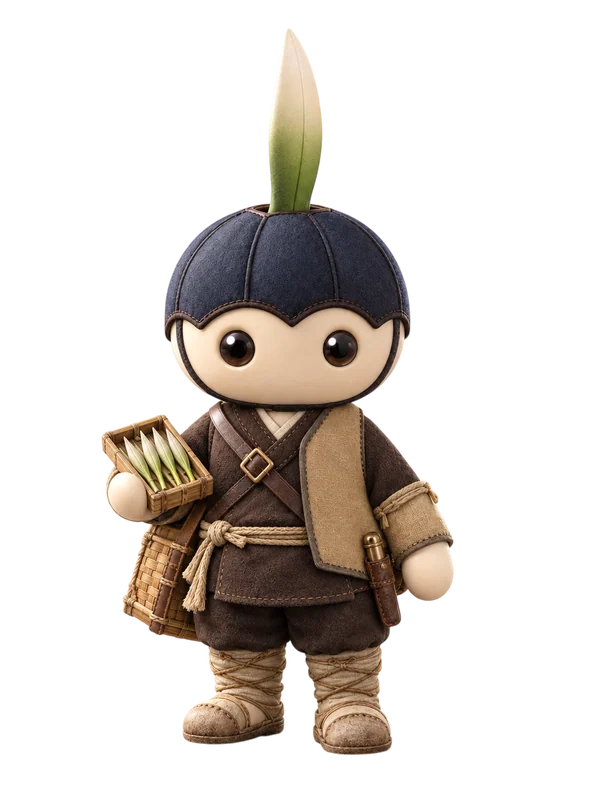
Tea. Wuyi oolong · 白鸡冠 bái jī guān
Headwear. 头巾 tóujīn · linen cloth with two ends
In one phrase. This is Bayczi: he sits by the coals and decides when the fire is enough.
Who he is
Bayczi is a palm-sized creature of the tea mountains who lives by fire. Not by a campfire or a stove, but by a bamboo basket of coals covered in ash: over such a basket, Wuyi oolong is finished. His head is smooth and earless, his hands are paddle-like without fingers, and his body is a rounded pebble the color of faded straw. On top of his head sits a low serrated crest — not a feather or a bony growth, but a leaf: in the 白鸡冠 bái jī guān cultivar, young shoots stay pale yellow while neighboring bushes have long turned dark green. His work is mostly waiting. He holds the heat even and low, takes the basket off in time, and then stays away from the finished batch for weeks until the roast settles into the taste. If asked what he does, the honest answer is: he makes sure nothing happens faster than it should.
Where he comes from
Wuyi 武夷山 wǔyí shān, northern Fujian province. Danxia terrain: pillars and walls of weathered red sandstone, with narrow gorges between them where direct sunlight reaches for only a couple of hours a day. The heart of the zone is the “three pits and two streams” 三坑两涧 sān kēng liǎng jiàn: 慧苑坑 huìyuàn kēng, 牛栏坑 niúlán kēng, 大坑口 dàkēng kǒu, 流香涧 liúxiāng jiàn, 悟源涧 wùyuán jiàn. Elevations here are modest, around two to four hundred meters, but the bushes stand on talus of weathered rock, in shade, near water. Bayczi comes from 慧苑坑, where 白鸡冠 has grown for a long time and where it is most often associated. But he did not appear on the cliff — rather, twenty steps lower, in the roasting room, a windowless chamber where rows of baskets 焙笼 bèilóng stand and the air holds the same temperature by day and by night.
How he relates to tea
Two things, the growth and the headwear, describe one stage of production: what grows and what fire does with it. The growth is the pale leaf. In 白鸡冠, the young shoot is yellowish-white, and green comes to it later and not fully; hence both the cultivar’s name and its palette. Bayczi’s crest is low, with three teeth along the edge and veins showing through along the rim — that is, a leaf in every feature that neither a feather nor a plate on a lizard’s back possesses. It runs along the midline of the skull because a leaf has only one midline. The headwear is a cloth 头巾 tóujīn, knotted strictly at the back, with two long ends hanging down the back. It is not decoration or ethnic costume, but a roaster’s work cloth: at the coal baskets it is hot, ash flies, and the head gets wrapped. The cloth sits exactly at the base of the crest, crossing it with fabric, and that is the whole idea: the fate of the pale leaf is decided not in the field, but here, where cloth meets growth. Fire for yancha goes by baskets: coals, a layer of ash on top as a regulator, a sieve with leaf above, several passes with rest in between. The pale leaf is thin in aroma, and strong fire straightens it into charcoal: therefore 白鸡冠 is usually taken with moderate heat where dense Wuyi cultivars take more. Bayczi is that cultivar adjustment made into a creature. The trim on his cloth is cinnabar — matching the rock the bush stands on.
What he does
- Levels the coals and covers them with ash again when the heat creeps up. The ash layer is not carelessness but a handle: add ash and the heat drops, rake it open and the heat rises. He checks with the back of his hand above the basket rim, never putting his palm into the heat.
- Turns the leaf on the sieve: lifts the sieve off the basket, rearranges the layer so the bottom and top swap, sets it back. He counts how many times he has turned it and keeps the count the same for the whole batch.
- Between passes, picks through the leaf by hand: removes stems, fragments, and yellowed pieces. This is 拣剔 jiǎntī, the most tedious part of the work, and he does it all, not just until he gets bored.
- Keeps records right on the basket rim: bush, gorge, harvest day, fire number, how many hours. He does not rely on memory — his memory is no better than anyone else’s, but the rim stays.
- Counts out the rest, 退火 tuìhuǒ. He seals the finished batch and keeps both himself and others away from it for several weeks, until the fire settles out of the taste and the tea becomes itself.
What he never does
- Never raises the heat to meet a deadline. Heat and time do not trade against each other for him: the fire is always lower than one wants, and longer than one wants.
- Never puts a batch on the fire before its rest is over. A second pass on unrested leaf he considers not acceleration but spoilage.
- Never brews tea on the day of roasting and never offers a taste. Fresh-from-fire tea lies about itself, and he will not pass that lie along.
- Never mixes leaf from different plots into one basket, even when there is only a handful of each. Mix them, and the record on the rim becomes a lie.
- Never predicts the taste in advance. Asked what it will turn out like, he answers with the bush’s name and the number of fires, and leaves it there.
Personality
Patient, precise, taciturn. By default he is in a state of steady waiting: sitting sideways to the basket, listening to the heat with his skin, doing nothing. This is not boredom or a sage’s calm, but a working posture — for most of a shift, the correct action is to not intervene. He perks up in two cases: when the heat rises and when someone reaches for an un-rested batch.
What he teaches
Through him it is easy to explain that the taste of Wuyi oolong is made not only by the bush, but by fire and the pause after fire. Roasting 焙火 bèihuǒ does not happen in one pass: basket, coals under a layer of ash, sieve with leaf, several passes, and between them the tea rests — 退火 tuìhuǒ. Fresh-from-fire tea is dry, sharp, and smells of campfire; several weeks later, the same tea opens up completely differently, though nothing was done to it. This yields two useful lessons for the student. First: if tea tastes “burned,” it is often not spoiled, just young in its fire. Second: the degree of fire is chosen for the cultivar, not by a general scale, and the pale leaf of 白鸡冠 takes less heat than its dense neighbors on the cliff — strong fire simply flattens it into the common Wuyi tone.
Season and hour
Season — from early May and on through summer into autumn. Yancha is picked late, by open leaf, once the bud has stopped, and after harvest begins the long part: roasting passes, rest, roasting again. His peak time is late May to August, when the roasting room is hot and nothing is happening on the cliff anymore. Hour — night. Roasting stretches for many hours straight, the air is steadier at night, and his shift falls between midnight and the gray light before dawn. He is one of two in the family who works in darkness, and the only one who works in darkness under a roof.
Who he crosses paths with
With Yanka the connection is direct and production-related: she handles rolling 揉捻 róuniǎn, and after rolling the leaf goes to fire, that is, to him. They hand each other the same batch on the same day and argue only about how moist the leaf may be when given over. With Aya — a polite divergence: her harvest standard 一芽二叶 yī yá èr yè does not apply to his tea; yancha is taken as mature leaf with the bud stopped, so his season starts later than everyone else’s, and he is used to waiting while the family works through spring. With Anczi they share a trait but not a cause: both have pale leaf, but Anczi’s comes from cold in early spring and then fades into green, while Bayczi’s holds by cultivar. They compare shades and each time confirm these are two different phenomena. With Pusha he sits at the opposite end: her white tea meets no fire at all, only air and time, and she considers his work unnecessary intervention, while he considers hers trust in weather. The dispute is old and won by no one. With Yanta they share the night: she wilts moon-white tea in the open air in shade, he keeps baskets under a roof. Sometimes they cross paths before dawn and barely talk. With Ugolek they trade seasons: his fires end by the cold, while Ugolek’s own slow warmth begins in winter in compressed dark tea. Both know that heat and time substitute for each other, and both dislike being rushed. With Zhunya they share a question about drying: she has full oxidation and drying after it, he has fire over partial oxidation, and the coppery tone comes differently in each. She comes to look at his ash. With Suncha it is simple: leaf from old bushes arrives later and takes fire differently, thicker and slower, so he waits for Suncha longer than anyone and keeps a separate hour count for it.
What is deliberately absent from the legend
The legend of the white cockscomb itself is rejected: the folk tale about a bird and about the tea healing someone drags in both a bird in the silhouette and a promise of benefit — both forbidden. The crest is left as a leaf, not a feather. The temple line is rejected: 白鸡冠 is usually told through a Daoist hermitage at the foothills and through its status as tribute to the court 御茶. There is no religion or historical figure in this world, and the tribute title is prestige, not a fact about the leaf, and it explains nothing in the legend. The headdress 鸡冠帽 of the Yi people is rejected: it literally coincides with the cultivar’s name and is harmful precisely for that reason — it doubles the crest, completes the bird, and appropriates a maiden’s headwear from another culture. The roaster’s work cloth was taken instead. The drama of fire is rejected: no taming of the elements, no keeper of the flame, no night vigil as an act of heroism. He has not a feat but a shift. Also rejected is membership in the “four famous bushes” as grounds for chosenness: the list is real, but the creature refers to the cultivar, not to a title.
What is fact and what is assumption
Facts that can be verified and remain if all fiction is removed.
- 白鸡冠 bái jī guān — Wuyi oolong 岩茶 yánchá, one of the “four famous bushes” 四大名丛 alongside 大红袍, 铁罗汉, 水金龟. The name translates literally as “white cockscomb.”
- The cultivar’s leaf is indeed light: young shoots are yellowish-white and green up later; this is a cultivar trait, not disease or fading. I state the reduced-chlorophyll formulation for a light-sensitive cultivar cautiously — it appears in the literature, but sources describe the mechanism differently.
- The geography is real: Wuyi in northern Fujian, danxia terrain, the 正岩 zhèngyán zone, the gorges 三坑两涧 — 慧苑坑, 牛栏坑, 大坑口, 流香涧, 悟源涧. 慧苑坑 is regularly named as the home of 白鸡冠. Elevations “two to four hundred meters” are rounded over the zone; a specific plot may sit higher or lower.
- The yancha process chain is real: 萎凋 withering, 做青 (with 摇青 and 晾青), 杀青, 揉捻, initial drying, sorting 拣剔, then 焙火 — roasting in bamboo baskets 焙笼 over charcoal covered with a layer of ash, in several passes, with rest 退火 between and after. Ash as a way to reduce heat is common practice, not imagery.
- Yancha is harvested by “open leaf” 中开面, three to four mature leaves with the bud stopped 驻芽, not by the 一芽二叶 standard. This is correct and sustains his relationship with Aya.
- That 白鸡冠 is taken with moderate fire relative to dense Wuyi cultivars is a craft norm, widely practiced, but it is practice rather than a written standard; I present it as practice.
- In 安吉白茶, the pale leaf is linked to low temperature in early spring and fades as it warms — this is a separate phenomenon from 白鸡冠, and in the Anczi point it is presented as such.
Artistic assumptions, for which I answer separately.
- The roaster’s cloth. Heat, ash, and sweat make a wrapped head a plausible working detail, but I have no precise documentary reference to a yancha roaster’s cloth specifically. It is a reconstruction of craft, not a quotation.
- “His hour is from midnight to dawn.” Roasting does indeed stretch for hours and often covers the night, but the specific window is a scheduling choice to spread the nine across the day.
- Records on the basket rim are fiction, grounded in the real habit of marking batches by bush, plot, and pass.
- Rest of “several weeks” is correct in order of magnitude: durations range from a couple of weeks to several months and depend on the degree of fire. I deliberately do not give an exact number.
- The creature itself, its character, prohibitions, and relationships with the other eight are entirely fictional. Nothing in the legend implies anything about the taste of a specific batch.
Separately, I note what was discarded as unverifiable: the rooster legend, the healing story, the temple origin, and the tribute-to-the-court status. All of this travels with the cultivar’s name, but is not a fact about the leaf.