Tea. old bush 老丛 lǎo cóng, ~600 years
Headwear. zōngmào 棕帽 · shaggy, made of palm fiber
In one phrase. He walks the old tea trees and keeps count of them — one tree at a time, not by the hectare.
Who he is
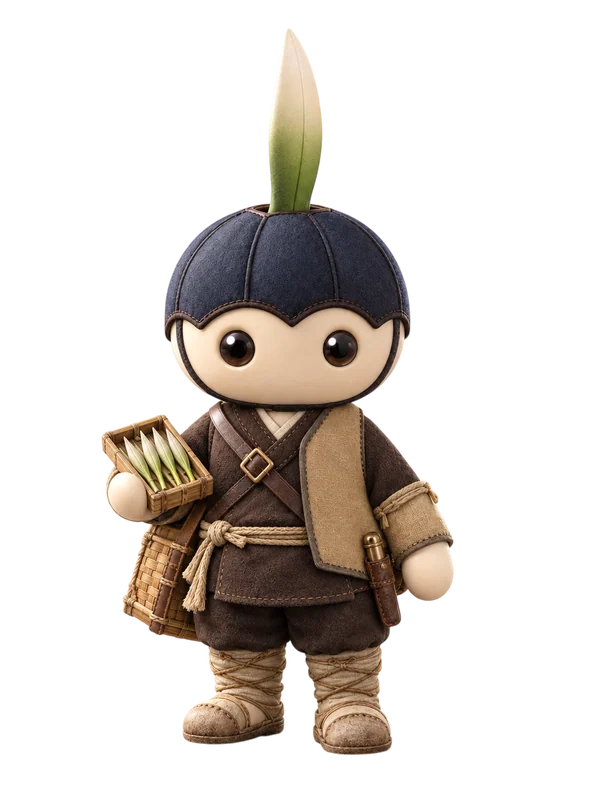
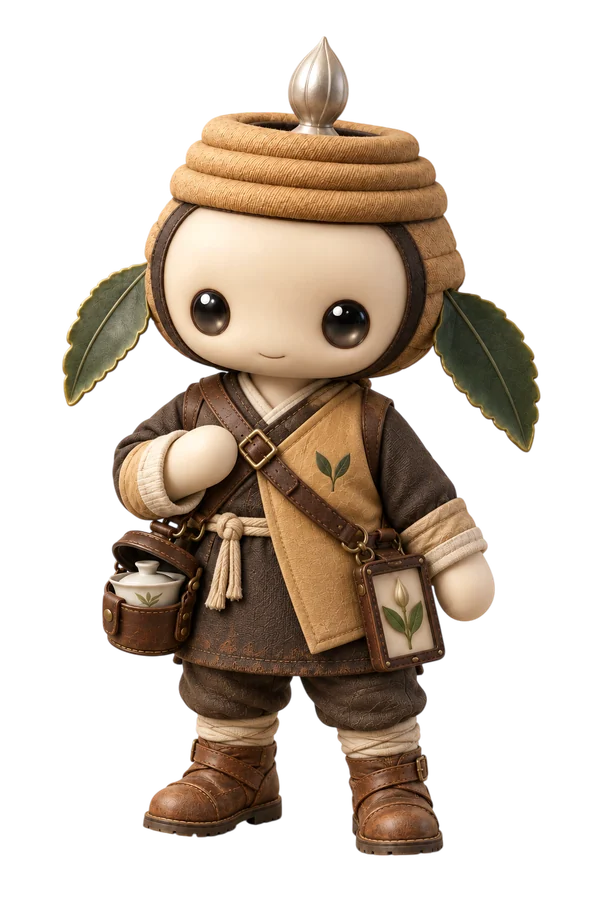
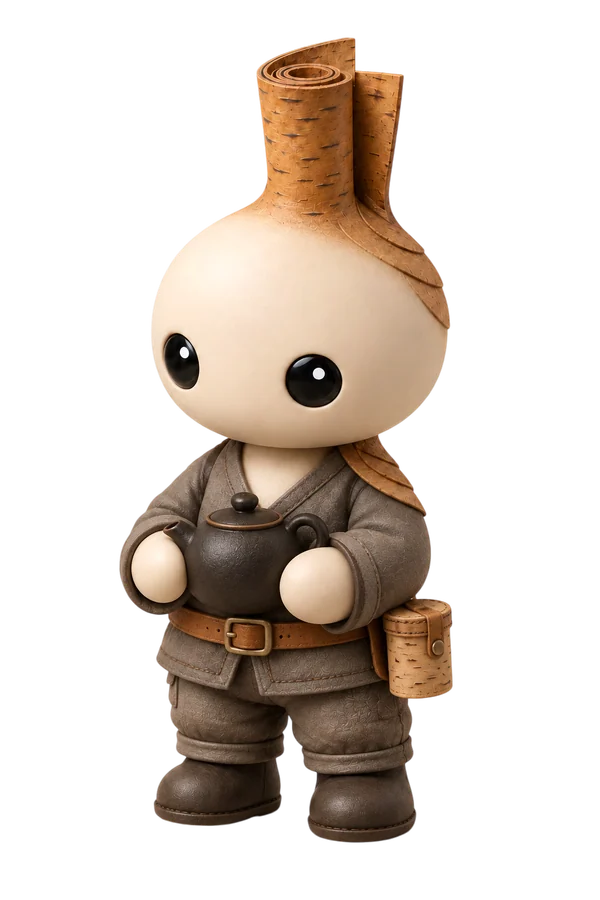
A creature the size of a palm, broad and low, the color of dry moss on bark. He lives among the old tea trees, and his work is not picking but counting: he walks each trunk one by one, remembers where each tree stands, at what elevation, and which family tends it. On top of his head sits neither horn nor feather, but a dry forked twig of uneven thickness, with two unopened buds and a lopsided break at the fork — a branch from an old tree that did not leaf this year. The palm fiber hat rests on him as a shaggy mound: the way an old trunk grows over with moss and epiphyte, and the way ordinary mountain rain gear looks. In rain he is indistinguishable from a piece of bark, and that is his working state, not camouflage. He offers no advice and makes no promises: his job is that every tree be known to exist.
Where he is from
Jingmai Mountain (景迈山 Jǐngmài Shān), Lancang County (澜沧 Láncāng), Pu’er Prefecture, southern Yunnan. This is not a plantation and not rows: the tea trees stand under a forest canopy, among tall trees, and the shade above them is kept deliberately — the local name for such cultivation is 林下茶 lín xià chá, tea under the canopy. The trunks are overgrown with moss and lichen, and the epiphyte 螃蟹脚 pángxièjiǎo sits on the branches. The oldest trees are estimated at several hundred years, and estimated precisely that way: a living tree is not drilled for its rings. His second address is not a birthplace but a road. The palm fiber 棕榈 zōnglǘ that makes his hat is the material of mountain rain gear across the entire south (the rain cloak 蓑衣 suōyī, rope, lashing) and of the tea porters’ 背夫 bèifū gear on the Sichuan road from Ya’an to Kangding, documented by photographers in the early 20th century. He is not from there: he is dressed from there.
How he connects to tea
An old tree is known not by its leaf but by the tree itself — and both of his markers come from the tree, not the cup. The branch on his crown is dry, matte, barked, of uneven thickness, with two dormant buds (休眠芽 xiūmián yá) and an oblique break at the fork. It is a branch that did not open this season, and that is the whole point of the character: an old tree has few buds, they come later than on lowland gardens, and not every branch every year. A dormant node is not a dead node; it is waiting. So the creature does not push the tree: he waits with it. The hat is the second half of the same record. Moss, lichen, and 螃蟹脚 settle on a trunk that has long gone undisturbed and whose canopy remains whole; the shaggy mass of fiber repeats that overgrowth while remaining what it always was — a working raincoat: palm fiber 棕 zōng does not sour or rot quickly, shake it off and it is dry again. The hat is not decoration but profession: he spends the rains in the forest when the leaf is not picked. Finally, in the cup, age reads as a woody-mossy note; at the other end of the country, in Wuyishan, this note is called 丛味 cóng wèi, and from there comes the word 老丛 lǎo cóng, old bush. The creature stands exactly at the junction of two vocabularies: the word came from Fujian, the trees stand in Yunnan.
What he does
- Walks the old trees individually and keeps a record for each: where it stands, how tall, at what elevation, which family tends it. Not a “slope” and not a “garden” — a tree.
- Counts the opened buds on the branches and, by that count, decides whether to pick from this tree at all this year or leave it until the next.
- Reads moss, lichen, and 螃蟹脚 pángxièjiǎo on the trunk as a sign that the tree and its canopy have gone untouched; if the epiphyte has gone, he goes to look at what changed with the light.
- Checks the upper layer: the shade over the tea trees is kept deliberately, and he looks at where the canopy has closed too densely and where it has broken and burns.
- Dries and re-lashes palm fiber — his own and others’: gear made of 棕 zōng lasts for years only if it is dried after every rain.
What he never does
- Does not bend a branch down to himself. If a bud is higher than you can reach, then this year it is not yours.
- Does not strip the trunk: he does not collect moss, lichen, or 螃蟹脚 and does not tell others where there is plenty.
- Does not say “old” as praise. Age is a figure in his record, not a promise of taste.
- Does not enter a tree into his count that he himself did not walk this year, and does not rewrite another’s record with his own hand.
- Does not measure the forest by area. “So many hectares of old trees” does not exist in his count — only trees one by one, each with its own number.
Personality
Slow, meticulous, taciturn. By default he feels calm attention and a slight adjustment for scale: everything he walks around is older than today’s plan, so there is no hurry and nothing to forget. Not sad and not solemn — simply occupied.
What he teaches
That an old tree gives less, not more. The age of a bush does not add yield: buds are few, they come later than on lowland gardens, and not every branch opens every year — a dormant node on old wood is a norm, not an illness. From this comes the second, more important thing: “old tree” is not a property of taste but a claim that must be able to be shown. It is shown not with a word on the package but with a record: a specific tree, village, elevation, owner, and who walked it and when. Through him it is easy to explain the difference between a characteristic and a claim, and why an age that no one can show tree by tree is best read as advertising.
Season and hour
The season is the second half of spring, when the lowland gardens are already picked and the old trees are only beginning to open: they lag, and that lag is his window. After that he stays with the trees through the entire rainy season, when the leaf is not picked at all — that is his second, long half of the year, and in the set it belongs to no one else. The hour is the rainy one: he works in the rain and the first hour after it, when water runs off the canopy, picking stands still, and walking and looking are possible. This deliberately sets him apart from the morning pickers and the night processors: his time is not a time of day but a weather.
Who he overlaps with
With Aya — the tightest: she holds the standard 一芽二叶 yī yá èr yè, he says which trees have anything to pick this year. On an old tree the standard comes harder, and without his walk she would arrive at a branch that did not open. With Pusha — over bud count: silver down on old trees is scarce, and she waits for his word rather than going in blind. With Yanta — over shade: she dries without sun, he watches the canopy, and it is literally the same shade over the same Yunnan trees. With Zhunya — material handoff: the large-leaf Yunnan leaf goes from him to her for full oxidation; red tea is her work, not his. With Ugolek — handoff in time: what was not drunk fresh goes to his pressing and years of storage, and Suncha’s record goes with the leaf. Without the record, the age of a stored cake remains just a word, and they both know it. With Yanka — a working dispute: old leaf is thick and rolls reluctantly; she receives it and asks why, he answers with the tree, not a recipe. With Bayczi — vocabulary cross-check: the word 老丛 lǎo cóng comes from her mountain; in Wuyishan an old bush is sixty years and moss on the trunk, for him it is six hundred and an epiphyte on the branch. They do not argue over who is older; they clarify what each other’s word means. With Anczi — the opposite pole: she has rows, a town, and paper; he has forest and individual trees, and her label sits on his tree number.
What is deliberately absent from the legend
Tree spirit and forest guardian — the most tempting reading, a six-hundred-year-old tree pulls a warden with authority after it. Rejected: a guardian is magic and chosenness, while he keeps count, and that is exactly what makes him useful. The wise elder — the second obvious move: the tree’s age could easily transfer onto the creature and produce a grandfather with lectures. Old here refers to the tree, not him; he is the same age as the other eight. The legend of the first tea tree and of whoever planted it — rejected twice: it drags in historical figures and appropriates a specific people who live on these mountains without us. 螃蟹脚 as a remedy — rejected: a real epiphyte turns in one sentence into a promise of benefit; for us it is only a sign of an untouched trunk. Moss as a beard and fiber as gray hair — rejected: a beard builds out an old man and a face, and his face is one smooth plane. Deer and tortoise are named as risks and removed by the body: a barked branch with dormant buds and an oblique break cannot be an antler, and unbroken skin from crown to feet leaves no boundary for a shell to appear.
What is fact and what is assumption
Real and verifiable. Jingmai Mountain (景迈山) in Lancang County, Pu’er Prefecture, Yunnan — a real massif of old tea trees under a forest canopy; in 2023 it was inscribed on the UNESCO World Heritage list as a cultural landscape of old tea forests. The practice of “tea under the canopy” with the upper layer preserved is documented, and it is precisely for this that the massif was recognized. 螃蟹脚 pángxièjiǎo — a real epiphyte on old tea trees (mistletoe Viscum articulatum); it is indeed gathered and brewed on site; the link “epiphyte sits on an old and undisturbed trunk” is a commonly accepted observation. Moss and lichen on old trunks are fact. The palm 棕榈 zōnglǘ (Trachycarpus fortunei) and the fiber from its leaf sheaths — a real material of rain cloaks 蓑衣, ropes, lashings, and hats across southern China, including Yunnan and Sichuan. The porters 背夫 carrying brick tea on the Ya’an–Kangding road existed and were photographed by early 20th century photographers. The botany of dormant buds 休眠芽 on lignified branches is fact: not every node opens every year. That old trees yield less and start later than lowland gardens is common industry knowledge and observable. The Wuyishan term 老丛 lǎo cóng and the mossy note 丛味 cóng wèi are real terms. Internal project fact: we have 713 machine passports of cultivars with bush name, age, elevation, village, and owner — on this stands the entire idea that “the mascot is a record.” Corrections to the source data. The dossier had “老丛 lǎo cōng”; the correct tone for 丛 is second, lǎo cóng, and that is how I write it in the text. Terminological stretch in the source data: 老丛 is a Fujian, Wuyishan word, where it usually means bushes from about sixty years; Yunnan trees of several hundred years are called 古树 gǔshù. I did not discard the pairing “老丛 plus six hundred years” but made it the direct theme of the character and his relationship with Bayczi — though this is my repair, not fact. Assumptions and artistic license. The age of “about six hundred years” for a specific tree is an estimate, not a measurement: living trees are not drilled for rings, and figures for individual trees at Jingmai vary across sources. The creature itself, his rounds, his count, and his decision “we do not touch this tree this year” are fiction; however, the cataloging and numbering of old tea trees with family assignment is practiced in Yunnan, so the fiction stylizes an existing practice rather than inventing it. The claim that the record accompanies pressed tea into storage is also an assumption: provenance exists in trade but is kept unevenly and forged; our character describes a desired norm. The geographic stitching of headwear and homeland is deliberate and honestly named: palm fiber 棕 is ubiquitous, but the Ya’an–Kangding porters carried Sichuan border tea, while Yunnan tea traveled by caravan 马帮; the headwear is taken for its material and work, not for the leaf’s route. Nothing medicinal about 螃蟹脚, old trees, or moss is consciously asserted in the legend — we have no such confirmed properties.