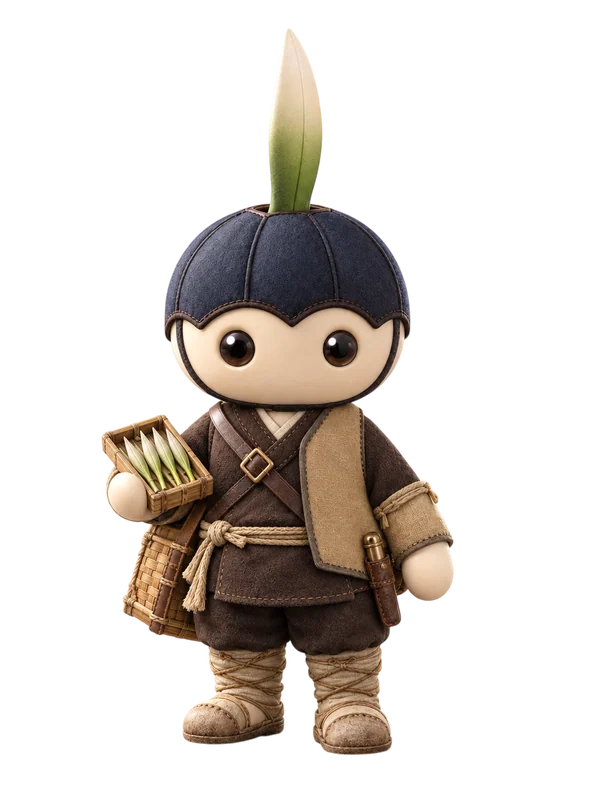
| People | Jino · 基诺族 Jīnuòzú |
| Region | Yunnan, Xishuangbanna: Youle Mountain (Jinuoshan), first of the six ancient tea mountains 古六大茶山 |
| Role | growers |
Tea
凉拌茶 liángbàn chá — a thick bamboo stalk is split in half to serve as a vessel, fresh leaves are kneaded by hand, mountain water is poured over them, and salt, pepper, garlic and camphor tree shoots are added. This is field food, not a drink.
Crown growth
A fresh leaf creased by fingers: folded in half along the midrib, snapped and drooping forward from the crown, the serrated edge clearly visible, with a dark bruise at the fold from pressure. Soft and wilting — the opposite of the stiff, dry growths of the others.
Headwear
A pointed hood-cape 尖顶帽 made of undyed hemp: a sharp spire on the crown with a slot for the leaf, a NARROW flat panel running from the spire down the spine to mid-back, while the shoulders stay bare. It differs from Ugolek’s hood precisely in this: his has a 30 mm shoulder cape and the weight rests on both shoulders, here the spire is taller and sharper, the shoulders are bare, and only a single narrow strip runs downward.
Clothing
A short jacket of undyed canvas with black and red bands at the hem and sleeves, leg wraps, and a basket on shoulder straps behind the back. In the hands, a bamboo trough split in two holding crushed leaf, salt and pepper.
Palette
Undyed canvas in three tones (from cream to grey flax), black and red bands, bamboo ochre. No green goes onto the headwear — the hood is canvas white.
Why this is not a caricature
It takes working field gear and field food — what is done in the garden, not at a festival. The custom is presented as a picker’s meal, not as an exotic tea salad: exoticizing words are banned on the card, and the description follows the craft. Not a single ritual object and not a single marker of age or marital status. Youle Mountain is named as a place, not as a trophy: the card states it is the first of the six old tea mountains, and stops there, without superlatives. The people are mentioned in the genitive case within a sentence, not via a hyphen after the character’s name.