tea.toys ENRU中文DEESFRJA

line two — 56 ethnic groups of China · a custom, not a rank

Bulan

This is Kvasha, keeper of the suancha custom: leaf fermented in a bamboo stalk, buried in a pit for four to nine months, and the bitter raw material of old gardens.

full GLB · Hunyuan · full GLB · Hi3D

downloads open after a one-email sign-in — that is how the registry knows its guests

drag to rotate — a light 2 MB copy; full models below

PeopleBulan · 布朗族 Bùlǎngzú
RegionYunnan, Xishuangbanna: Bulan Mountain, villages of Laoman’e and Laobanzhang; northern slope of Jingmai (Manjing settlement)
Rolegrowers

Tea

酸茶 suānchá — leaves are fermented without air in a bamboo trunk buried in a pit for four to nine months; plus bitter raw material 苦茶 kǔchá from old gardens. The 普洱景迈山古茶林 landscape has been on the UNESCO list since 2023.

Crown growth

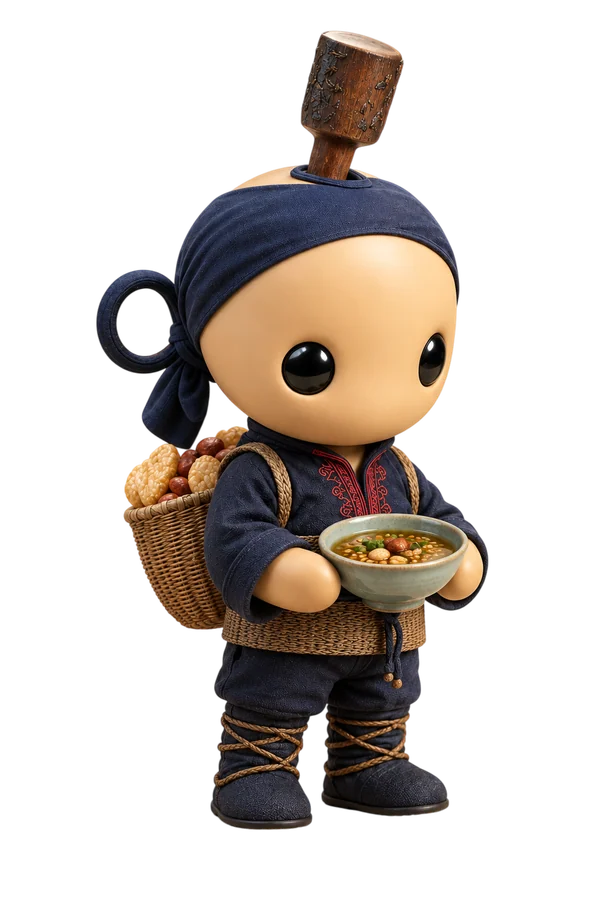
A dense mass of compressed fermented leaf: a squat dark olive plug with a cut-off top, leaf edges of packed leaves protruding from the sides, the surface matte and seemingly damp, with an earthy deposit at the base. No regular geometry — the shape comes from how the mass pushes out of a bamboo node.

Headwrap

包头 bāotóu — a dark wrap laid in a low flat band wider than the skull, with a slot cut for the growth; a fresh tea shoot tucked diagonally into the wrap at the side. Identification is carried not by the wrap itself, but by the PAIR: two large disc ear-spools extending horizontally on either side of the head. At 6 mm this is the only outline with two side projections at ear level next to the nine — none of their headdresses has horizontal protrusions, and it differs from Aya’s ring-roll by being wider than the skull and bearing a diagonal twig.

Clothing

A short dark indigo cross-front jacket, shrunken and worn from use; a long tube skirt with a single narrow red-and-white band at the hem; a woven sash wound three times; leg wraps; a plaited basket hung at the hip, not on the back. In the hands, a short bamboo node caked with earth — the thing just pulled from the pit.

Palette

Indigo to near black in three tones, a red-and-white band at the hem, lacquered ochre of bamboo, a single silver dot on the sash. No green on the headdress — the wrap stays in the indigo range (hue about 225).

Why this is not a caricature

The everyday clothes of the pit and garden were chosen, not festive wear: festive silver on a tea mountain would be as out of place on a Bulan highlander as a kokoshnik on a potato. Not a single ceremonial or ritual item; 茶魂树 and everything around it is not depicted at all. The people are not named in the title or the stock code — they appear only in the card text as bearers of the custom, and the unit of the set is the custom itself (sour tea in bamboo), so the character does not become “people number such-and-such.” The creature’s body is non-anthropomorphic and faceless, which is the only basis for ethnic caricature: there is nothing to exaggerate. The ear spools are rendered at actual size, not doubled, and without pendants — feature amplification is forbidden. The card states directly that the figure is a fictional creature, and the clothing is simplified to fit the form and is not a costume sample.

On the tea map

Yunnan

← back to the line