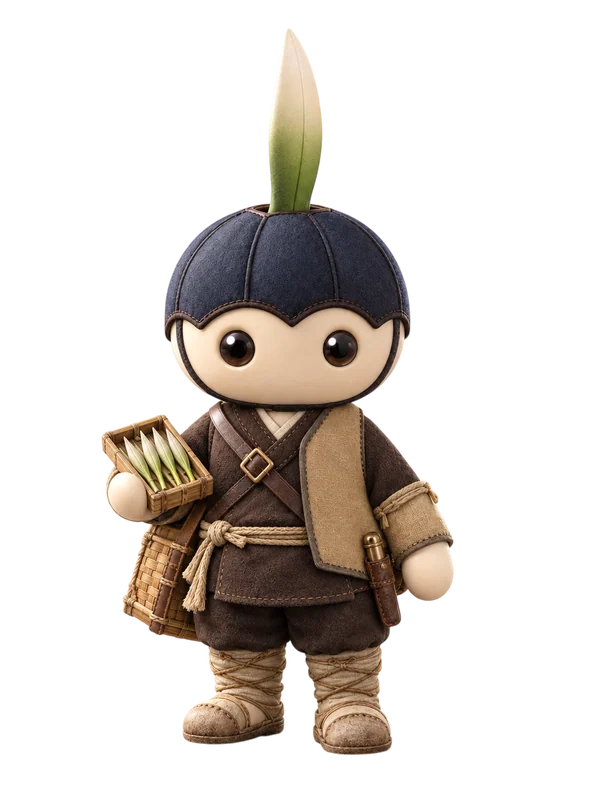
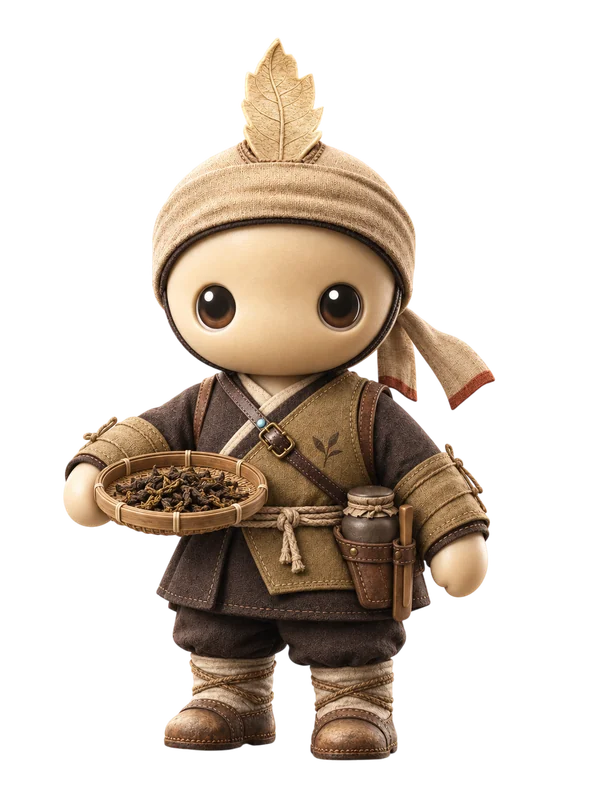
Tea. oolong · 揉捻 róuniǎn, leaf rolling
Headwear. 斗笠 dǒulì · conical bamboo
One line. This is Yanka — he rolls the leaf and knows which turn to stop on.
Who he is
Yanka is a palm-sized creature living where green leaf is brought to oolong. He does not pick tea and does not brew it: his work begins in the evening, when the leaf picked during the day has already wilted, and ends toward midnight, when the leaf has been rolled into tight knots and passed on to the fire. He rolls the leaf. Counts turns, breaks apart a clumped ball, rolls again. On top of his head sits one closed bud, hooked forward; on his cheeks, below the eyes, grow two leaves rolled into tight spirals — jade-green at the center, with a copper-red rim along the edge. That is, he is himself made of what he makes: the edge reddened before the center curled, and along it you can read the order in which the work went. If you had to explain him to someone hearing of him for the first time, the shortest way is this: a record of oolong written on a body that can walk and very much dislikes hurrying.
Where he is from
Anxi (安溪 Ānxī), a county in Quanzhou prefecture in southern Fujian, on the southeastern foothills of the Daiyun range (戴云山脉 Dàiyún Shānmài). The place is specific: “inner Anxi” (内安溪 nèi Ānxī) — the high, foggy, cool half of the county, as opposed to the low coastal one; the town of Xiping (西坪镇 Xīpíng zhèn), from which Anxi counts its tieguanyin. The landscape is not plantation terraces on flat ground but broken hills with red-yellow soils, narrow valleys, and village tea sheds where drying racks stand right in the yard. He appeared not on a bush and not in the forest, but in that shed — between the yard where the leaf is withered in the sun and the dark room where it is then bruised. He considers the threshold between them his home, not any single mountain.
How he relates to tea
Oolong is the only class where oxidation is stopped halfway, and that stop is visible to the eye: the leaf is first shaken and tossed in bamboo sieves (做青 zuòqīng, 摇青 yáoqīng), which bruises and tears precisely the edges, and the edges redden — yielding “green leaf with red border” (绿叶红镶边 lǜ yè hóng xiāng biān). Only after this is the leaf heated and rolled — 揉捻 róuniǎn, and in Anxi it is also rolled in a canvas bag (包揉 bāoróu), over and over breaking apart the clumped ball (解块 jiěkuài) and drying it between wrappings until the leaf settles into a tight spiral. Yanka carries both marks on himself, in the right order: the border on his cheek leaves is red along the edge while the center stayed jade, and on top of that the leaf is rolled into a spiral with a seam along its length. First the edge, then the form. The bud on the crown is closed and hooked forward — and that, too, is not decoration: oolong is not picked with the bud, it is taken “by open face” (开面采 kāimiàn cǎi), when the shoot has grown two to four mature leaves and the bud is no longer needed. Yanka is the one whose bud was not plucked. It stays closed, and its hook repeats in miniature the very curve he spends the evening pressing into the leaf. The douli hat (斗笠 dǒulì) works on the same seam of craft: wearing it he steps into the yard where the leaf is withered in weak sun (晒青 shàiqīng), and takes it off as he enters the dark room — and he uses the hat brim as a portable shade, holding it over the sieve to read the border color in even light rather than through glare. Remove the fiction from all of this and what remains is a description of Anxi oolong processing.
What he does
- Tests the leaf for pliability before work: takes a shoot by the petiole and bends it slowly. It snaps with a crack — too early, the leaf is still full of water. It bends without breaking — it can be rolled.
- Counts turns aloud. A ball in a canvas bag is rolled not “some amount” but by number; after each wrapping he stops, breaks apart the clumped ball with his paddle hands, and recounts, because an unclumped ball is a new count.
- Spreads the leaf across bamboo sieves in a thin even layer and tosses it from the bottom up, lifting from the center toward the edges: he watches not the leaf as a whole but the rims, because it is always the rim that reddens.
- Reads from the width of the red border how many times a batch was shaken and whether they stopped in time. About someone else’s leaf he does not say this aloud; about his own he does.
- Carries the dried ball to a short heat and back. Between wrappings the leaf must become warm and soft again, or the next pass will break it rather than roll it.
What he never does
- Does not tear the leaf to speed things up. A torn leaf releases juice at once and muddies the infusion, and Yanka would rather skip an evening than take by force what time gives on its own.
- Does not leave a rolled ball lying unopened. A warm dense ball suffocates inside, and this is the only thing that makes him raise his voice — or rather, stop speaking entirely and go break it apart himself.
- Does not take the leaf out into the midday sun. Only weak morning and evening sun; in heat he simply waits, and answers every question by saying he is waiting.
- Does not say “approximately.” Not about turns, not about time, not about charcoal temperature. If he has not counted, he says he has not counted, rather than name a round number.
- Does not judge tea by dry leaf. A rolled ball hides both a torn edge and a border and someone else’s carelessness; Yanka waits until the leaf unfurls in water, and only then speaks.
Character
Patient, counting, unhurried. By default he feels an even “not yet” — not anxiety and not boredom, but a calm readiness to wait one more round. His joy is also a counting kind: it comes not when a batch is done, but when the leaf on some pass first settles by itself, without pressure.
What he teaches
Through him it is easy to explain the one real peculiarity of oolong: its oxidation is partial and proceeds from the leaf edge inward. The leaf is shaken in sieves, the rims bruise and redden, the center stays green — hence “green leaf with red border,” and the width of that border shows how much the leaf was shaken and where it was stopped. Next comes the practical consequence that anyone can check at home: dry oolong is rolled and shows nothing, so you should look not at the dry leaf but at the brewed one — take it out of the pot after a steep, spread it flat, and look at the edge. An even narrow red along the whole rim with a green center means the work is done; a solid brownness means oxidation went further than intended; torn black shreds with no clear edge mean the leaf was handled roughly. One leaf laid out on a saucer explains the entire class better than any description of flavor.
Season and hour
Autumn. His harvest is the autumn one (秋茶 qiūchá), the one Anxi takes around 寒露 hánlù, in the first half of October, valued for its high dry aroma. In the day, his time is from sunset to midnight: oolong is finished at night, the evening goes to shaking and resting in sieves, the first half of the night to rolling. Around midnight he hands the work on and goes to sleep; the pre-dawn hours are no longer his.
Who he overlaps with
With Aya he has a disagreement over measures, and it is the most working relationship he has. She is the standard of “one bud two leaves” plucking, and oolong needs a different plucking, by open face, without the bud, from a mature shoot. What for her measure has already stood too long only begins to be suitable for Yanka, and he takes from her the leaf she herself would have rejected. Bayczi takes over his work: Yanka ends where he begins — the rolled ball goes to the coals, to the roast, and both of them are oolong, only one makes the form and the other the fire. With Zhunya he shares one operation and diverges in purpose: both she and he roll the leaf, but she needs the rolling to release the juice and carry oxidation to the end, while he needs it to catch the form and stop at the border. His border is her beginning. With Anczi they argue about when to heat: for green tea the heat stops oxidation immediately, for Yanka only after the edge has reddened, and their whole conversation is always about one hour of difference. With Pusha he does not work but checks himself against her: her leaf is not rolled at all, and to understand what rolling actually does, Yanka goes to look at a leaf no one has touched. He gives the coarsest leaf to Ugolek — for oolong it is late, but for dark tea mature material is just right, and what autumn does not take, winter claims. With Yanta they are shift partners by the clock: he leaves around midnight, she works after, and their handoff is not by leaf but by time. Suncha comes rarely, from an old bush, and Yanka rolls his leaf separately and more gently than the rest, on a shorter count than usual.
What is deliberately absent from the legend
The first thing that suggested itself and was rejected was the origin of the name tieguanyin — the legend of the iron statue of the goddess of mercy. It is recognizable, beautiful, and directly forbidden: religion does not work in this world, and Yanka cannot be anyone’s messenger. The second rejected thing is the figure of the master who “feels the leaf on his skin and knows without counting.” That is exactly the blogger fairy tale the whole set is made against: here it is the opposite — he counts turns aloud, and the number can be written into the batch passport next to the altitude and the village name. The third is the “dragonfly head,” the common nickname for a rolled Anxi ball: animating it into a creature would mean adding a second animal to the world and breaking the principle that there are no speaking objects here. The fourth is giving the hat a function. I wanted to write that the douli protects him or gives him power; in fact it is just for the sun, indoors he hangs it on a nail, and its only job beyond that is an even shadow over the sieve. The fifth is dawn, the basket, and the carrying pole. The morning picking in the fog was not taken from him by oversight but removed deliberately: Yanka is not a picker, his hour is the evening, and without a basket on his shoulder the cone stays a peasant’s hat rather than a postcard.
What is fact and what is license
Real and verifiable. Anxi (安溪) in Quanzhou prefecture, Fujian, is the generally recognized birthplace of tieguanyin; the town of Xiping (西坪) is traditionally called the place of its origin; the division into “inner” and “outer” Anxi (内安溪 / 外安溪) is real and means the high foggy part of the county against the low coastal one; the county lies on the southeastern foothills of the Daiyun range. The whole processing chain is real: wilting in weak sun 晒青, shaking and resting in bamboo sieves 做青 / 摇青, rolling 揉捻, Anxi rolling in a canvas bag 包揉 with the mandatory breaking apart of the clumped ball 解块 and intermediate drying between wrappings. The marker “green leaf with red border” (绿叶红镶边) is real, and so is its cause: the whole leaf is shaken, but the edges bruise and oxidize first because that is where the cells tear. The oolong plucking “by open face” (开面采) is real — a mature shoot without the bud, unlike the bud standard 一芽二叶. It is real that oolong finishing happens in the evening and at night, not during the day. The autumn harvest around 寒露 (usually October 7–9) is real, and so is the reputation of autumn Anxi oolong as the most aromatic. Real are 斗笠 as the everyday conical headwear of all of southern China, the Wuyishan charcoal roast 焙火 as a separate profession, and the fact that dark tea is made from coarser mature material. The practice of judging leaf color in even shade rather than under direct sun is standard. Artistic license. The creature itself, of course, and its whole biography. The turn count: rolling in the bag is indeed repeated many times, the order of magnitude cited in sources varies and depends on the workshop and the material, so I do not name a specific number anywhere — “counts aloud” is a character trait, not an industry norm. The use of the hat brim as a portable shade over the sieve is invented, though plausible; I have not cited and would not find a documented description of such a technique. The claim that old-bush leaf is rolled more gently and on a shorter count is a plausible but unconfirmed norm; it is a plot detail for the sake of the connection to Suncha. The distribution of the nine across operations, calendar, and hours is entirely a construction of the set: real workshops are not divided that way, one person carries a batch from wilting to the fire. I deliberately do not name altitude, yield, or other numbers for Anxi, so as not to pass a rounded figure off as data. The line about a leaf laid out on a saucer anyone can verify, but the phrasing “an even narrow red means the work is done” is a simplification: the edge is read together with aroma and infusion, and no final conclusion is drawn from a single leaf.