tea.toys ENRU中文DEESFRJA

line one — the nine · bound to the constellation

Yanta

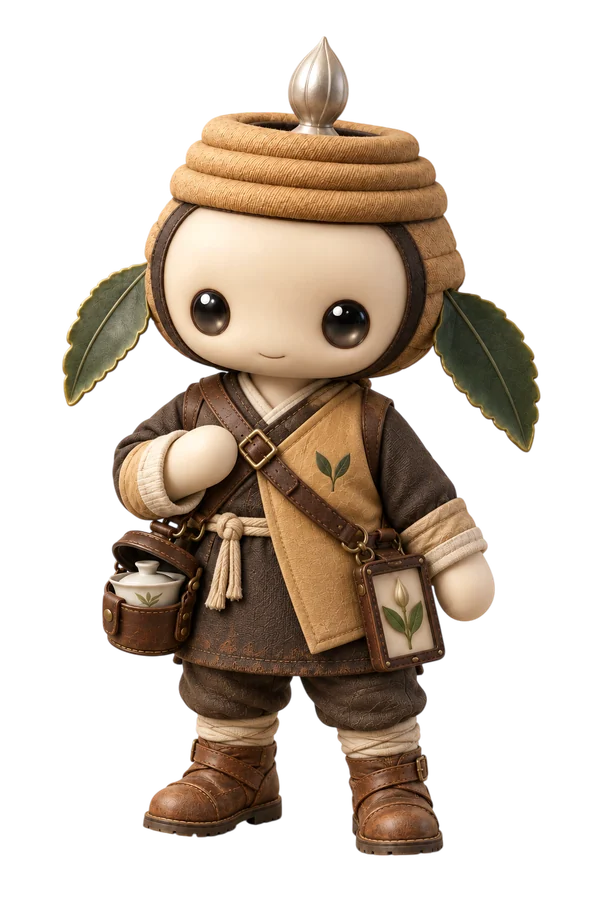
This is Yanta — she guides the leaf through the night and does almost nothing to it, which is why the leaf stays two-toned: dark on top, silver underneath.

full GLB · Hunyuan · full GLB · Hi3D

downloads open after a one-email sign-in — that is how the registry knows its guests

drag to rotate — a light 2 MB copy; full models below

Tea. White · 月光白 yuèguāng bái, sunless drying

Headwear. 抹额 mò’é · wide quilted brow band

In one phrase. This is Yanta — she guides the leaf through the night and does almost nothing to it, which is why the leaf stays two-toned: dark on top, silver underneath.

Who she is

Yanta is the night worker of the withering loft. Palm-sized, on long smooth legs, with a small earless head, a flat calm face, and paddle arms hanging empty. On her crown stands a single broad leaf, almost vertical, dark on the front and pale on the back. Her body is built the same way: grey-green back, pale silver underside, with a clean line between them. She does nothing to the leaf with her hands. Her work is air and time: spread it in a thin layer, shift the sieves between tiers all night, keep the draft and the darkness, keep direct sun away. By morning the leaf looks almost the same as it did in the evening, and that is the whole point of her work.

Where she comes from

Yunnan, Pu’er Prefecture, Jinggu County (景谷, Dai and Yi autonomous), Minle Township 民乐, Yanta Village 秧塔 — homeland of the local cultivar 秧塔大白茶 yāngtǎ dàbáichá, a large-leaf bush with abundant down on the leaf underside. The area sits on the southern slopes of Wuliangshan 无量山, humid mountain subtropical zone, with villages and old plantings at roughly 1500–1800 m, near the Lancang River valley. The same tea’s second address is Lincang 临沧: the same large-leaf bush, the same shade withering. She appeared not in the field and not under the open sky, but in the withering loft: a tiered wooden rack, bamboo sieves, shutters on two sides, and a constant draft.

How she connects to tea

The core is moon white 月光白 yuèguāng bái. It is a Yunnan white tea with no firing and no rolling: only withering 萎凋 wěidiāo and drying 干燥 gānzào. The large-leaf bush’s leaves are withered indoors, in shade, without direct sun, so they stay whole and two-toned: the front darkens to nearly grey-green and brown, the underside keeps its white down. Hence the name: dark on one side, light on the other — like the moon. Yanta’s two-tone body is that same record: grey-green back and silver underside, with the boundary running along the edge of an unprocessed leaf. The growth on her crown is not a bud but a single whole broad leaf with a raised midrib on both faces, dark front and pale back: it stands unrolled because no one kneads her tea. Her headwear is a wide quilted brow band 抹额 mò’é, pearl grey, made of undyed homespun. She has two reasons, both practical. First: it is the only headwear that adds nothing upward and hangs nothing downward, and in the withering loft it cannot be otherwise — the sieve tiers sit close together, and any brim or visor would catch the lower edge of the shelf above her head. Second: color. Pearl-grey quilting is the tone of her own leaf’s underside, not whiteness and not mourning white wrapping; here the moon is carried by material, not by form.

What she does

What she never does

Temperament

Slow, nocturnal, observant. By default — calm waiting: she does not mind watching nothing happen for hours on end, and she does not treat it as downtime. Toward dawn she turns a little drier and more precise in her movements, because that is when the decision is made: take the sieves down or give it one more night.

What she teaches

Through her it is easy to explain that white tea is defined not by what is done to the leaf but by what is not done to it. White tea has neither firing 杀青 shāqīng nor rolling 揉捻 róuniǎn — only withering and drying. And that shows on the leaf itself, without a word: if the leaf is whole, not twisted into a rope, dark on the front and with intact white down on the underside, then it was neither kneaded nor heated. The two-tone leaf is not decoration and not a grade but a trace of process. From there comes a second, more mature step: learning to read from the tea what was done to it, instead of trusting the label on the package.

Season and hour

Season — spring, late March and April, when Jinggu runs its main harvest; a second pass in autumn, September–October. Hour — from sunset to first light. An important honest caveat inside the legend itself: withering lasts two to three days and inevitably spills into daylight, so the night is her time, not the tea’s. At night the loft belongs to her: the air is even, there is no sun, no one carries leaf past. By day others use the same room, and the leaf keeps lying without her.

Who she crosses paths with

Aya hands her the leaf. Aya holds the picking standard 一芽二叶 yī yá èr yè, and moon white uses the same — a bud with two leaves; baskets arrive at day’s end, and from that moment the leaf becomes Yanta’s business. Pusha is her classmate and her opposite in light: both make white tea, but the Fujian tradition withers with the sun’s participation, while moon white withers in shade, so Pusha kept the down on the bud and Yanta kept it on the underside of a whole leaf. Yanka comes to her for the first hours: oolong also starts with withering, and up to a certain point their leaves lie together on the same sieves; they part where Yanka takes her leaf to knead and shake, while Yanta does not touch hers at all. Zhunya works with the same Yunnan large-leaf bush as she does, but drives it to full oxidation — one leaf, two opposite fates, and the clearest way to explain that is through the two of them. Ugolek takes what Yanta does not take: the coarse mature leaf and stem she cannot use go to dark tea. Suncha tells her which old trees can be picked this year and which should be left to rest. People constantly confuse her with Anczi, and it is a working confusion, not a joke: his 安吉白茶 ānjí báichá has “white” in its name, but it is a green tea whose leaf goes into a hot wok that same evening; her leaf will never see a wok. Bayczi is the far end of the same line: he lives by the coals at 焙火 bèihuǒ, and he and Yanta stand at two ends of one scale, from the complete absence of fire to its direct application.

What is deliberately absent from the legend

The moon as a character. It was the most tempting thing: the tea’s name practically says “withered by moonlight.” Rejected because it is exactly the kind of blogger fairy tale the whole set is built against — and it is also untrue to the process: withering runs two to three days indoors, in shade, not under the night sky. The moon stays where it actually is: in the leaf, dark on one side and light on the other. Then — the crane. Long legs, a small earless head, and a two-tone back pull toward a wading bird, so the legend has no water, no standing on one leg, no scanning of anything below; her legs are explained by work at tall tiers and steps between sieves on the floor. Headwear with a circular veil 面帘笠 was rejected separately: it covers the face. No silver plaques or pendants: Jinggu is a Dai and Yi autonomous county, and specific ethnic attributes would turn the creature into a folk costume; the cloth is left undyed. The saying “one year — tea, three years — medicine, seven years — treasure” was not used: it is a storage saying, not a fact, and it would drag a promise of benefit into the legend. And no hierarchy: Yanta is not “the purest” or “the most ancient” of the nine, she simply has her own shift.

What is fact and what is assumption

Real and verifiable. 月光白 yuèguāng bái is a Yunnan white-type tea from the large-leaf bush (Camellia sinensis var. assamica), made in Pu’er and Lincang; withering happens indoors, in shade, without direct sun, without firing and without rolling. White tea as a class is defined by two operations — 萎凋 withering and 干燥 drying (GB/T 22291). The leaf’s two-tone appearance is a real marker of this tea: dark front and light downy underside. Jinggu County 景谷, Minle Township 民乐, Yanta Village 秧塔, and the cultivar 秧塔大白茶 all exist; the cultivar is historically tied to the tribute 白龙须贡茶 and known for abundant down. 安吉白茶 is indeed a green tea despite “white” in its name. Dark tea is indeed made from coarse mature leaf and stem. Oolong and white tea indeed begin with shared withering and diverge at the 做青 stage. Dianhong from Fengqing and Lincang is made from the same large-leaf bush. Bamboo sieves 水筛 and tiered withering racks are real equipment. Artistic assumption and caveats. Night as her personal shift is an assumption: withering lasts two to three days and includes daylight, and I made the night watch a dramaturgical device, stated plainly in the text. The reasoning “a brim catches the lower shelf of the rack” is plausible but my construction, not documented practice. The “Fujian in sun, Yunnan in shade” difference is real but not absolute: Fujian uses both 日光萎凋 and 室内萎凋 and combined withering, so the contrast with Pusha is a simplification for clarity. Moon white’s classification is disputed: GB/T 22291 was written for Fujian cultivars, and some specialists place 月光白 not in the white class but in a Yunnan borderline technique; I present it as white, but that is a position, not an uncontested fact. The origin of the name “moon white” itself is not reliably established: the “two-tone leaf” version is reasonable and widespread, the “withered under the moon” version is vendor folklore, and I do not use it. The 1500–1800 m elevations and the precise orography “southern slopes of Wuliangshan” are approximate and need map verification; the mother trees at 秧塔 are around two centuries old (Qing era), not millennia, so there are no “ancient trees” in her legend. End-of-withering signs (soft edge, bending stem) are described as craft guidelines, not standards: in norms this is set by moisture content, not by feel.

Wardrobe — 39 project costumes

every costume is a project of THE TEA constellation

Yanta — costume of the academy project
academy
Yanta — costume of the atlas project
atlas
Yanta — costume of the community project
community
Yanta — costume of the degree project
degree
Yanta — costume of the doctor project
doctor
Yanta — costume of the dog project
dog
Yanta — costume of the energy project
energy
Yanta — costume of the equipment project
equipment
Yanta — costume of the events project
events
Yanta — costume of the express project
express
Yanta — costume of the fitness project
fitness
Yanta — costume of the florist project
florist
Yanta — costume of the furniture project
furniture
Yanta — costume of the glass project
glass
Yanta — costume of the gratis project
gratis
Yanta — costume of the mafia project
mafia
Yanta — costume of the main project
main
Yanta — costume of the money project
money
Yanta — costume of the photo project
photo
Yanta — costume of the place project
place
Yanta — costume of the puerh project
puerh
Yanta — costume of the report project
report
Yanta — costume of the restaurant project
restaurant
Yanta — costume of the school project
school
Yanta — costume of the services project
services
Yanta — costume of the shop-puerh project
shop-puerh
Yanta — costume of the shop project
shop
Yanta — costume of the style project
style
Yanta — costume of the support project
support
Yanta — costume of the surf project
surf
Yanta — costume of the taxi project
taxi
Yanta — costume of the teamotea project
teamotea
Yanta — costume of the toys project
toys
Yanta — costume of the travel project
travel
Yanta — costume of the us-com project
us-com
Yanta — costume of the villas project
villas
Yanta — costume of the wholesale project
wholesale
Yanta — costume of the worldtea project
worldtea
Yanta — costume of the yoga project
yoga

Scenes

Yanta in the scene

← back to the line