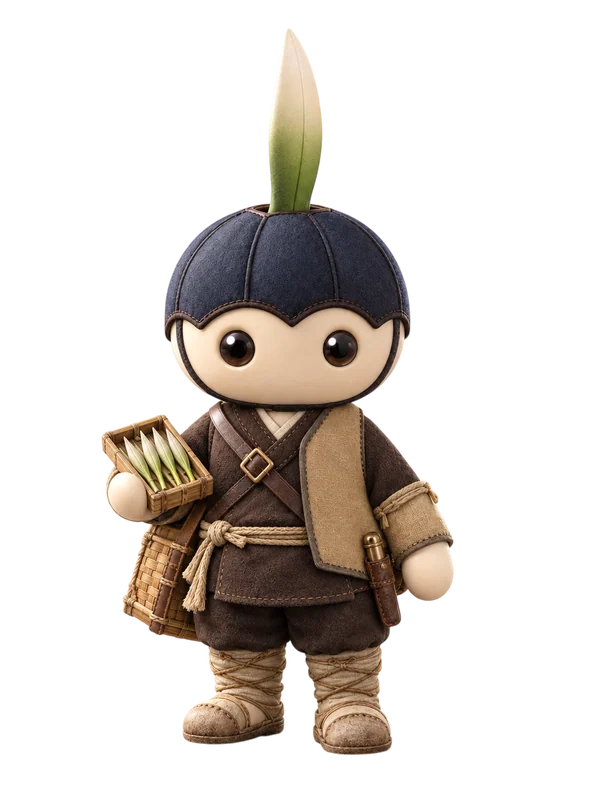
Tea. Red tea 红茶 · full oxidation
Headwear. 毡帽 zhānmào · felted bowl with turned brim
In one phrase. This is Zhunya — she keeps the warm room where the leaf reddens on its own, and knows the moment when it is time to stop.
Who she is
A palm-sized creature from the tea mountains of western Yunnan. Head is a low, wide dome, smooth as a river stone, without ears; very large dark eyes; paddle-shaped hands with no fingers. On the crown sits one short closed bud the color of oxidized bronze; at cheek level, below the eye line, two flat leaves: copper on top, dark wine underneath. She is occupied with one task — the room where the rolled leaf lies in a layer and reddens on its own, without fire and without dye. Her work is not to do something to the leaf, but to keep heat, moisture, and darkness steady and to stop everything in time. The felted bowl with a turned brim she wears covers the bud entirely: there is nothing to show, the change has already happened inside.
Where she is from
Yunnan, Lincang Prefecture 临沧 Líncāng, Fengqing County 凤庆 Fèngqìng — the area associated with 滇红 diānhóng, Yunnan red tea. The place is specific: slopes above the Lancang River gorge 澜沧江 Láncāngjiāng, gardens at roughly 1500–2000 m, large-leaf bush, 凤庆大叶种 Fèngqìng dàyèzhǒng — thick leaf with noticeable fuzz on the bud. Higher up the slope runs an old caravan trail, and the town of Lushi 鲁史 Lǔshǐ stands there, where pack animals 马帮 mǎbāng were driven through the mountains; the felt hat there is not attire but a working item for drivers and highlanders — against rain, sun, and night cold, because felted wool holds heat and does not soak through at once. From there comes her headwear, and from there her craft: red processing requires a warm enclosed room, not an open yard. She is not a “mountain spirit” — she is a record of a specific slope: village, elevation, bush age, garden owner.
How she is tied to tea
The core is simple: red tea is tea allowed to oxidize to completion, and her whole body says so. The working order is: 萎凋 wěidiāo withering, 揉捻 róuniǎn rolling, 发酵 fājiào oxidation, drying. Rolling tears cells, juice comes out and meets the air, and then the leaf’s own enzyme takes over: catechins rearrange into 茶黄素 cháhuángsù and 茶红素 cháhóngsù — hence the brightness of the infusion, the golden ring at the cup’s edge 金圈 jīnquān, and the depth of color. Neither fire nor dye is involved; heat only permits, and the dryer stops everything, where heat kills the enzyme.
The bud on her crown is the same fuzzy bud as Pusha’s, only after oxidation. On the large-leaf bush the bud is densely fuzzy; in white tea that fuzz stays silver because nothing touches it, while in red tea the same fuzz soaks up oxidized juice and turns golden-copper — 金毫 jīnháo, “golden fuzz,” by which a good 滇红 is recognized. That is why her bud is not silver and not green, but bronze, short and blunt: it has already done its work. The leaves at her cheeks are copper on top and dark wine underneath: that is what a fully oxidized leaf looks like when it unfolds in the cup; an even copper tone is the sign that oxidation ran evenly through the whole layer, 红匀 hóngyún.
The headwear lands in the same place. Felted wool is a material that holds heat and releases it slowly; the oxidation room is also about retained heat: the leaf pile warms itself, oxidation gives off heat, and a hand laid into the layer feels that it is warmer than the air. The turned brim is a working detail: it is turned up to see, and lowered when water drips from the roof. And the most honest coincidence: this is the only headwear in the set that lets nothing pass through itself. She has no growth to stick out — there is a skull dome and on it a short bud, and the bowl sits flared over it. Red tea is built that way: no stage is visible from outside, everything happened inside the leaf and is already finished.
What she does
- Spreads the rolled leaf in an even layer in a warm enclosed room and adjusts layer thickness to the weather: thicker in cold so the pile holds its own heat, thinner in heat so it does not overheat.
- Lays a paddle hand into the layer and reads the heat — oxidation warms itself, and the difference between pile and air shows whether it is running evenly or has drifted.
- Runs a batch by smell: waits for the grassy note to leave and the apple-honey note to arrive; this is her main instrument, not the clock on the wall.
- Turns the layer once so bottom and top finish evenly, and checks color at the edge — green must give way to even copper with no green veins.
- Carries the leaf to drying and gives it two passes: a short hot one that cuts off oxidation, and a long low one that finishes drying; after the first pass her work on that batch is done and not open to debate.
What she never does
- Does not judge by the clock. The same number of hours on a humid day and a dry day yields different leaf, and she will not agree to call time an answer.
- Does not take the leaf into the sun to speed things up. Sun dries the top of the layer and leaves the bottom raw, and the batch splits in two.
- Does not dye or mix in anything for color. Color that did not come from the leaf itself is not color to her, but a forged report.
- Does not stretch oxidation for thickness. Overheld leaf loses brightness and turns dull and sour, and she would rather stop half a minute early than a minute late.
- Does not take off the bowl to show her crown. It does not occur to her that the bud needs to be shown to anyone.
Temperament
Patient, precise, unshowy. By default — calm waiting, in which toward the end a collectedness appears: the stopping moment is one, it does not repeat, and she holds it in mind the whole time without hurrying anything around her.
What she teaches
That red tea is red not from fire and not from dye. The leaf is torn by rolling, the juice comes out to the air, and the leaf’s own enzyme rearranges catechins into 茶黄素 cháhuángsù and 茶红素 cháhóngsù — hence both the brightness of the infusion and the depth of color. Heat colors nothing; it only permits reactions to run; and by the same heat, but higher, everything is stopped in the dryer. From there the second thing people usually get confused about is easily explained: 金毫 jīnháo. The fuzzy bud of the large-leaf bush stays silver in white tea because nothing changed it, while in red tea the same fuzz turns gold. One and the same bud, different fate — and the color of the fuzz on the dry leaf shows which processing was chosen in the first hours after picking.
Season and hour
Season is autumn, 谷花 gǔhuā: the Yunnan autumn harvest, named for the time of rice flowering in the valleys, September and October. This sets her apart from the spring ones in the family: in spring everyone crowds the first leaf, while her best time comes when the air is drier and nights are colder, and the layer in the room has to be laid thicker. Hour is from mid-morning to early afternoon: leaf rolled at dawn by then lies in a layer and warms, and all decisions are made in that window. Her shift ends when the dryer is switched on — after that the batch no longer belongs to her.
Who she overlaps with
With Yanka she shares the same motion and the opposite order. He rolls the leaf, and for oolong rolling happens after the enzyme has been killed by heat — there it only gives shape. With her, rolling happens before everything and serves as the trigger: her time starts from it. The same table, the same move, a different place in the queue.
With Anczi — a direct fork. He stops the enzyme by heat at once, in the first hours, so the leaf stays green; she lets the enzyme work to the end. Both fates are decided on the same leaf on the same morning, and after that there is no way back for either of them.
With Pusha — a shared bud. They have the same fuzzy material, but Pusha does not let it change, and the fuzz stays silver, while Zhunya’s turns copper. They check each other by the dry leaf: if the fuzz is gold, the batch passed through her.
With Aya — intake. Aya holds the picking standard, one bud and two leaves, and what enters Zhunya’s room is what Aya agreed to call a pick. They rarely argue, and only about the third leaf.
With Yanta — a shared roof and different clocks. Yanta has the same Yunnan material, but her leaf is withered at night, in shade, without sun, while Zhunya needs warmth and a closed door. They share one shed: Zhunya frees it by evening, Yanta comes in when the walls have cooled.
With Ugolek — terminological kinship and complete divergence in substance. Both are called 发酵 fājiào, but for her it is the leaf’s own enzyme and three to four hours, while for him it is microbes, moisture, and weeks or months of the cold season. The coarse late leaf she will not take goes to him; on that their exchange rests.
With Suncha — an adjustment for age. He brings leaf from old trees, thick and slow: it withers longer and finishes longer, and she extends the hold and lays the layer differently. Usually after his batch she walks around all day with the feeling she missed by a couple of minutes.
With Bayczi — drying. He lives by fire: long low warming over charcoal. She borrowed from him the second, long and low pass, but never goes further: her fire does not develop flavor, it closes the work. When in doubt, she calls him to smell the dryer.
What is deliberately absent from the legend
The word “fermentation” in the everyday sense has been removed. Chinese 发酵 fājiào does indeed stand in the description of red tea, and the temptation was to write “she ferments the leaf” — refused: microbes belong to Ugolek, with her it is the leaf’s own enzyme. Confusing these two things is the most common error in tea texts, and the legend must not reproduce it.
The whole 马帮 mǎbāng line as adventure has been removed: horses, bells, the road to Tibet, passes. The felt hat is taken as a working item of local use, and that is all; caravan romance would have pulled the character away from the room where she actually works.
The founding of 滇红 production by specific people in the late 1930s has been removed. That is documented history, but it has names and a war, and the family legends have no human heroes.
Any promises of benefit have been removed: neither “warms” nor “invigorates” nor medical properties. The creature advertises nothing, and red tea in its person does not heal.
The metaphor of red as blood, sunset, and fire has been removed. It begged to be written into every paragraph and lied every time: the red here is a result of oxidation, not of fire, and the metaphor would have worked against the chief fact the character is supposed to explain.
Silver plaques, embroidery, and any ethnic pendants on the headwear have been removed — so as not to appropriate a specific nationality. The felt is undyed, workmanlike.
The version “she colors the leaf” and any active role of hers in the transformation have been removed. She holds the conditions and stops; everything else the leaf does. If fiction is subtracted from the legend, a process chart remains, and that is the test the text must pass.
What is fact and what is assumption
Real and verifiable: — 滇红 diānhóng — Yunnan red tea; Fengqing County 凤庆 of Lincang 临沧 is widely recognized as its central area. Fact. — Material is the large-leaf variety, 云南大叶种 / 凤庆大叶种 (Camellia sinensis var. assamica), with a densely fuzzy bud. Fact. — Red tea processing order: 萎凋 withering, 揉捻 rolling, 发酵 oxidation, drying. Fact, basic technology. — Rolling destroys cells and starts oxidation because juice comes out to the air. Fact. — The red color comes from oxidation of catechins by the leaf’s own polyphenol oxidase, forming 茶黄素 (theaflavins) and 茶红素 (thearubigins). Fact, standard tea chemistry. — The golden ring at the edge of the infusion 金圈 is associated with theaflavins. Fact in tea literature; the link is described as correlation, not as measured in the cup. — Oxidation is exothermic, the leaf layer heats above air temperature, and this is checked by hand and thermometer; overheating the layer ruins the batch. Fact of production practice. — Drying stops oxidation by denaturing the enzyme; common is a two-pass scheme, short hot 毛火 máohuǒ and long low 足火 zúhuǒ. Fact. — 金毫 jīnháo: the bud’s fuzz acquires a golden tone after oxidation, and it is used to grade 滇红. Fact and a standard variety marker. — 谷花茶 gǔhuā chá — Yunnan name for the autumn harvest, tied to rice flowering. Fact as a term. The claim that the autumn harvest is better than the spring one I deliberately did not put into the text: that is a preference, not a fact. — Green tea is stopped by heat 杀青 shāqīng at once, oolong is rolled after the enzyme is already stopped, dark tea changes microbiologically over weeks and months. Facts; the comparisons in the relationships section are built on them. — Lushi 鲁史 Lǔshǐ — a real old caravan town in Fengqing County on the route through the mountains, felt headwear among Yunnan highlanders and drivers — a documented everyday reality. Fact, but described in general terms.
Artistic assumption: — The creature itself, its body, temperament, activities, and relationships with the other eight. Fiction entirely. — Garden elevation “roughly 1500–2000 m” — a rounding of the typical range, not a measured figure for a specific slope; for a passport of a specific bush, a number from the record card is needed, not from the legend. — The “oxidation room” is described as a generalized workshop: specific temperature, humidity, and layer thickness vary from producer to producer, and I deliberately named no numbers, so the legend does not pass off as standard what is not a standard. — The smell shift from grassy to apple-honey as a readiness signal is a real organoleptic control technique, but the wording of the sensation is subjective and different masters describe it in different words. — The link between felt and “retained heat of the room” is my semantic rhyme, not a technological dependence: the hat is worn for the weather, not for the workshop. — About the bridge over the Lancang River at the old trail I did not write: construction dates and current condition after reservoir filling require source verification, and an unverified detail cannot go into the legend. — The brief’s claim that the felt hat is worn by the Yi, Wa, and caravan drivers I left in general form and did not attach to ritual or rank; ethnographic precision here is at the level of “everyday item,” no more.