tea.toys ENRU中文DEESFRJA

line two — 56 ethnic groups of China · a custom, not a rank

Han

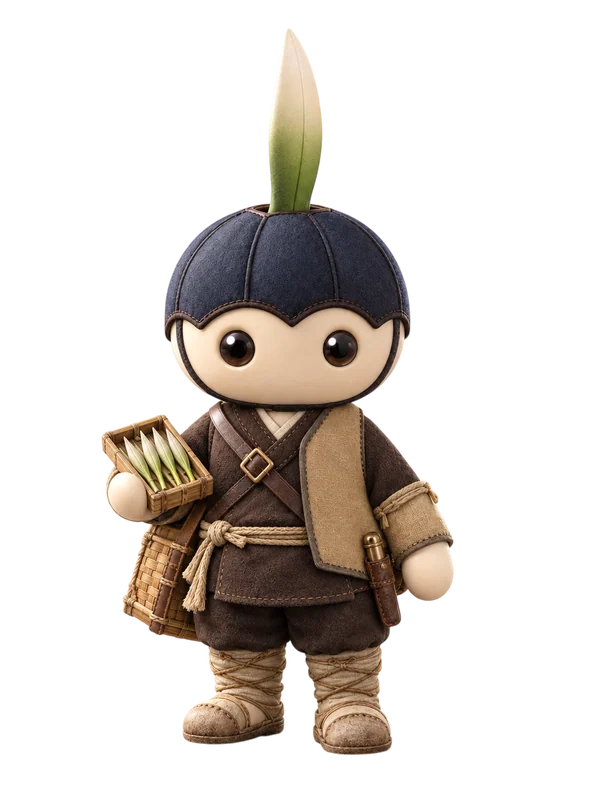
This is Tolkusha, Han who drink their own way: the leaf is not steeped but ground in a clay mortar into a thick paste-porridge.

full GLB · Hunyuan · full GLB · Hi3D

downloads open after a one-email sign-in — that is how the registry knows its guests

drag to rotate — a light 2 MB copy; full models below

PeopleHan ·
RegionWidespread; leicha lives among the Hakka of Hunan, Guangdong, Jiangxi and Fujian
RoleThey drink in their own way

Tea

擂茶 léichá — the tea is not brewed but ground, and in Han practice it is a living remnant of the pounded tea of the Tang and Song eras. Fresh leaves go into a clay mortar 擂钵 léibō with grooved walls about half a meter across, and are ground with a stick 擂棍 léigùn cut from the trunk of an oil camellia 茶油树 cháyóushù or hawthorn, about 85 cm long, with sesame, peanuts, beans, rice and herbs added along the way; the pulp is lifted out with a bamboo sieve-ladle 捞子 lāozi. The result is a thick paste-porridge eaten with rice, not a clear infusion. The custom survives among the Han of several regions, and is preserved most fully by the eastern mountain branch — the Hakka of Hoiyang, Longgang, Meizhou and Gannan, whose technique 赣南客家擂茶制作技艺 is listed in the national intangible heritage register. Work attire: in 凉帽 liángmào women went out to the tea slopes; the craft is about two hundred years old in Gankeng and over three hundred in Danshui.

Growth on the crown

A 炒青 leaf lifted from the wok wall and standing on the crown EDGE-ON: a broad thin slab in dark olive tone, both longitudinal edges rolled inward into tight cylinders flush against each other with no gap at all, a pressed vein along the axis, russet iron scorch marks on the flat face. Thickness is a third of the width, height is twice the width — at 6 mm, a narrow upright blade with two thickened rims. Differs from Dai’s pressed-tea cylinder in that it is a plane, not a body of revolution; from Yi’s leaf ring — in that the rolls are sealed shut and no background shows through them; from Va’s charred slab — in that it stands vertical rather than lying flat; from the Manchus — in that there is no crown growth at all, only a tiny tea bud in place of the cap’s button knot; from Gaoshan — in that that one is a slab laid flat at full width with readable serrations, while here the leaf is folded at its edges into a narrow blade edge-on.

Headwear

凉帽 liángmào, a sun shade: a flat circle of thin bamboo splints roughly 45 cm, with a standard central opening of about 15 cm; a FULL curtain of sheer dark blue gauze, six cun wide, is sewn along the rim and hangs to the shoulders around the entire circumference without a single gap — the face stays visible through it. The slot is not invented — it is that very opening in the middle of the crown: the blade passes through it edge-on, the splints grip it from both sides, and the circle lies horizontal.

Silhouette at 6 mm. A disc with a circular skirt. Differs from Pusha’s 平顶笠 in that that one has a bare rim and an open neck, while here a continuous curtain hangs around the whole circumference to the shoulders; from Yanka’s cone 斗笠 — in the complete absence of a crown above the top of the head; from the flat pancake of the Miao — precisely in the skirt, which is therefore never shortened or broken at any level of simplification.

Clothing

A blue canvas jacket with an asymmetric overlap and rolled-up sleeves, a waist apron for gathering, knee pads, and a bamboo sieve-ladle tucked into the belt.

Palette

Indigo of the curtain and jacket, straw-yellow bamboo splints of the circle, warm worn wood of the pestle, gray-green note of the ground leaf.

On the tea map

GuangdongFujianZhejiangAnhuiHenanShaanxiJiangxiJiangsuShandongBeijingShanghaiChongqingHebeiShanxiTianjin

← back to the line