Print files, open
Every figure in the registry is made to be printed, and the file that prints it lives here with the numbers behind it. A one-email sign-in opens the downloads — that is how the registry knows its guests. The 3MF, the passport and the measurements exactly as the slicer produced them.
A project of Teamotea. Everything here was measured on a real slicer, and where a number of ours turned out to be wrong we say so and give the corrected one. If you re-measure and get something else, that is worth more to us than agreement.
The first print files will appear once the colours are laid out: each figure is painted by hand in hi3D at 2048 quality, and the finished 3MF with its passport lands on this page. Draft variants are gone — only quality files get published; heavy files are served from our media store. While the files are in the works, every 3D model lives in the workshop.
What is in the file
Each 3MF is a complete Bambu Studio project: the mesh, the per-face colour assignment across four spools, and the machine profile of an H2D Pro with a 0.4 nozzle. Open it, load the four spools listed in the passport, print. Nothing else to set.
What the measurements say
Three things decide what a figure costs to print, and none of them is the 3D engine.
Purge dominates. A 63 mm figure holds about 17 g of plastic and burns about 185 g printing alone: nine tenths goes into flushing the nozzle at every colour change. Printing nine at once leaves the number of changes almost unchanged while the figures multiply — 20 hours becomes 4.5 per figure, 185 g becomes 36.
Colour count is expensive. On the same mesh: four spools print in 20.2 h and 185 g; six in 36.7 h and 376 g; eight in 47.6 h and 585 g. The green robe of the gatherer only appears at the eighth spool, and it costs three quarters more machine time than the whole figure in four browns.
Colour laid out by height is worth more than any of it. We repainted the same mesh into horizontal bands, placing the band edges optimally so the result matches the real costume over as much surface as possible. The printer then changes filament only at a band edge.
| layout | hours | changes | grams | matches costume |
|---|---|---|---|---|
| by texture, as published above | 20.16 | 561 | 185.3 | — |
| 4 bands | 1.92 | 1 | 23.1 | 45.3% |
| 6 bands | 1.99 | 2 | 23.7 | 48.4% |
| 10 bands | 2.14 | 6 | 25.6 | 52.4% |
| 16 bands | 2.33 | 10 | 27.5 | 54.2% |
Ten times the speed, eight times less plastic — and the purge that ate nine tenths of the material almost disappears. But the gain is not free, and the picture shows the price: half the surface no longer matches. The straps, the buckle, the boots and the basket collapse into a flat belt. The figure prints in two hours and stops reading as a gatherer.
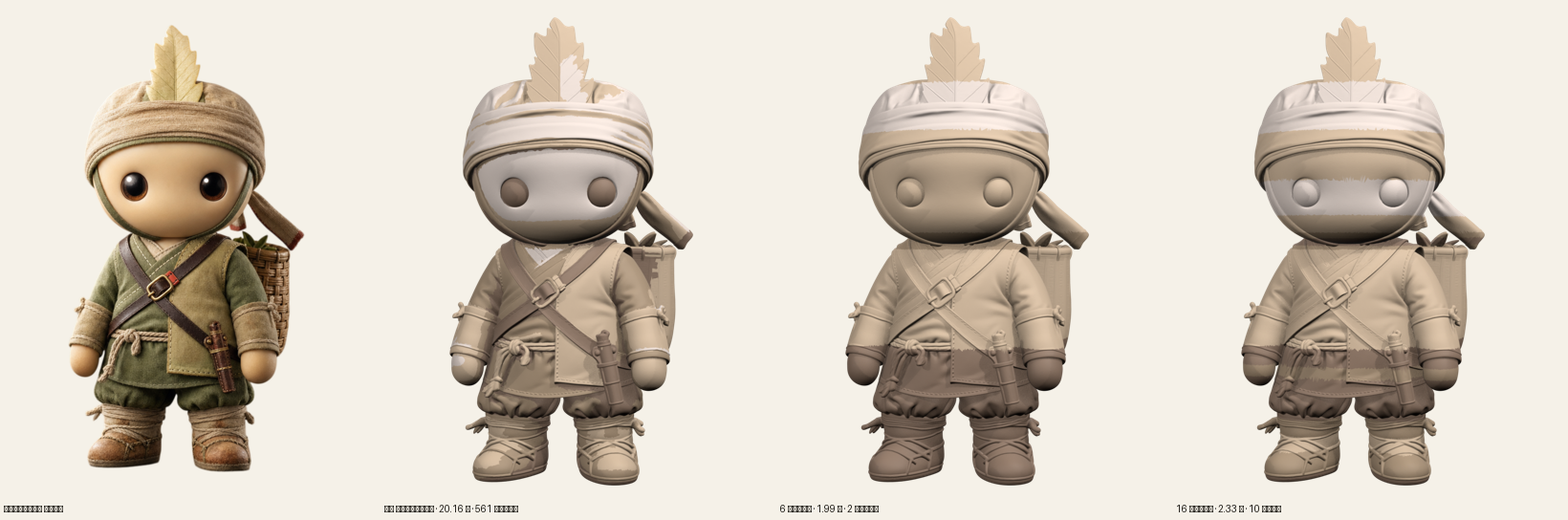
So banding is a way of drawing, not a post-process. Applied to a finished model it erases the costume. It belongs in the frame: draw the character so each colour naturally occupies one continuous belt of height — hat, jacket, trousers, boots — and never scatter an accent across three heights. Then the two hours come without losing the character.
Which 3D engine
We measured two, on two characters, through the same pipeline. On the printer they are equal — the difference in hours is two to five per cent. They differ in price: Tencent Hunyuan 3D Pro costs $0.50 per figure, hi3d Quality $4.00 for the same printed result. hi3d returns a cleaner back side; Hunyuan keeps colour better, because hi3d's de-lighting also eats saturation. hi3d Master, at $9.20, was slower and heavier on every line than hi3d Quality — density a 0.12 mm layer cannot see.
How the file is made
The pipeline takes a textured GLB from any engine and returns the 3MF and the passport. It samples the texture per face and then selects a subset of the real Bambu spool catalogue — you print with what is sold, not with an ideal RGB.
Choosing that subset by minimising colour error alone does not work, and we can prove it rather than assert it: we enumerated all 292,825 four-spool subsets of the catalogue under 21 different weightings, and the palette a good human tool picks is never the error minimum — its best rank is fourth. Error minimisation keeps buying a second brown one lightness-step away from the first, because baked shading dominates the variance, and dissolves a whole hue into it. Two rules fix it, both measured:
- No two spools closer than dE 20. This is the load-bearing rule. On the gatherer it recovers the green robe outright.
- At least one light spool (L* ≥ 75) when the figure has light areas. Without it the florist's face, hands and feather — 5% of the surface above L*70 — printed caramel-brown, off by 24.6 dE.
What that bought, measured on the slicer: the gatherer went from 20.16 h and 185.3 g to 19.26 h and 178.8 g; the florist from 13.64 h and 132.5 g to 10.24 h and 100.6 g — a quarter less of both — and got her pink robe and cream face back.
python3 scripts/mascot/glb_to_3mf.py \
    --glb MODEL.glb --name NAME --out DIR --colors 4
One trap worth passing on, because it cost us a day: exporting to GLB splits vertices along UV seams, so the slicer sees a heap of patches instead of a body — 2 794 components on a figure that looks solid. It refuses with a Voronoi error, and any island-counting quality metric lies by orders of magnitude. Weld vertices by position before anything else.
Who publishes this
The mascot line, these files and the measurements behind them belong to Teamotea, and they are published as an open project — public use for non-commercial purposes: download, print, remix. The decision was made on 25 August 2026. The characters and the line stay ours; for commercial use, write to us. A print file nobody can check is a claim, not a result — that is why everything here is open.
Can you do better?
Colour separation is handwork, and your layout may beat ours. Write to [email protected] — we will publish it here under your name, and the best ones we will take together all the way to a sellable print file.