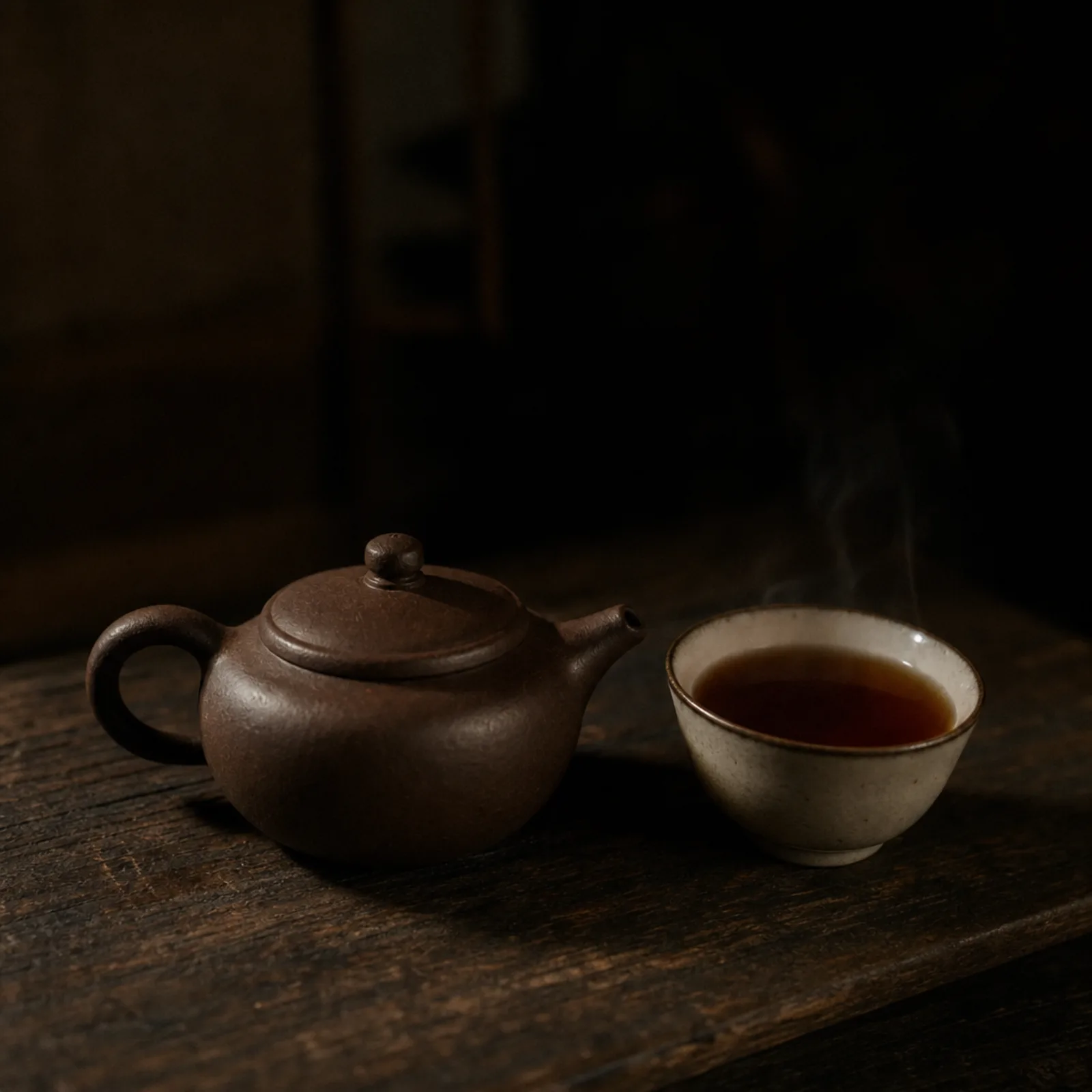
From Yunnan leaf to Yixing clay — a procurement journey
Michael joined Teamotea as a field buyer for tea, covering the tea mountains of Yunnan and the oolong villages of Fujian. He learned to read a tea tree’s age by the bark, and a farmer’s craft by the stillness of the withering room. When tea.toys was being shaped, the team needed someone who could bring the same lot-level rigour to collectible clay — someone who wouldn’t just select pretty figurines, but would sit with the maker, feel the texture of the raw zisha ore, and understand why a certain toad was worth a ten-hour drive.
He started with the obvious: the dragon kilns of Dīngshū, in Yixing. The town has made purple-sand teapots for six centuries, but only a handful of families had turned their hands to cháchǒng — the tea pets that live on a chábān, fed with the rinse water of each session. Michael spent his first three months there doing almost no buying. He apprenticed observation: he sat with Lǎo Wú’s son while forty little dragons were being burnished, watched how a duànní buffalo changes colour across four firings, and catalogued the signature chops that prove a piece is from a particular lineage.
Soon those months turned into a rhythm. Four times a year he returns to Dīngshū, timing his visits to kiln openings — the moment when the firebricks are pulled back and the week’s firing is revealed. A lot might contain sixty píxiū and only seven pass Michael’s eye. He looks for the same qualities a tea master looks for in a finished tea: clarity of form, an invitation to touch, and a trace of the human hand that made it. A toad that will darken slowly under years of pu-erh, its back becoming a map of pour lines. A zhūní qilin that will glow hotter red with every rinse.
He also travels south to the porcelain workshops of Dehua, in Fujian, where the white clay has been sculpted into guānyīn figures and sleeping children for a millennium. Here he sources the delicate incense holders and the miniature guardian lions that sit on a tea tray’s edge. His Fujian roots from the tea world gave him an entry — the same families that grow Tieguanyin often have cousins in the Dehua ceramic guilds — and he built a network based on shared ritual and mutual trust.
When a product arrives on tea.toys with a note “sourced by Michael Zhan,” it means exactly that. He has shaken the master’s hand, watched the piece being glazed, and often posted a field note on tea.travel about the morning he found it. He believes that every object in a tea room should come with a story you can taste — and with provenance you can trust.
Dīngshū and the dragon kilns
The Dīngshū district of Yixing is built on yellow dragon mountain — Huánglóngshān — whose stratified ore has fed generations of potters. The classic zisha clays — zǐní (purple), zhūní (cinnabar red), duànní (fortified beige) — are dug from distinct seams, each yielding a different porousness and a different response to tea. Michael walks the mines (now mostly sealed, with ore stockpiled by the government) and visits the small stone mills where the raw rock is ground to dust and hand-sieved 80 times through silk.
From there the clay travels to the family workshops — no larger than a living room, with a window facing a bamboo grove. The potter throws or slab-builds the tea pet, carving the scales of a dragon or the belly-folds of a three-legged toad with a single knife he has sharpened for forty years. The drying takes a week; the firing, in a remodelled dragon kiln or a modern electric furnace, takes another two days. Michael arrives at the final unstacking. He checks the colour — a zhūní pixiu that has blushed evenly across its haunches is kept; one with a dull patch goes back into the master’s private collection. He also visits Dehua in Fujian, where the porcelain clay is milkier and the firing atmosphere produces a warmer ivory white. The small-ware and incense stands he selects there share the same ethic: a piece that asks to be used.